By Viraj • September 2, 2026
BBA: Completing a Bachelor of Business Administration (BBA) can be an exciting moment, but it can also bring a lot of confusion. After spending three years learning about management, business, marketing, finance, human resources and entrepreneurship, many students suddenly find themselves asking, “What should I do after BBA?”
If you are asking the same question, don’t worry. You are certainly not alone.
A BBA degree is designed around business and management, which means it can become a starting point for many different careers. You can enter the corporate sector, pursue an MBA, prepare for government examinations, work in banking and finance, build a career in marketing or human resources, learn digital skills, enter sales and business development, or even start your own business.
There is no single career that can be called the “best career after BBA.” The right choice depends on your interests, strengths, financial situation, academic performance and the kind of professional life you want.
The modern higher-education system is also becoming more flexible. The University Grants Commission (UGC) says its undergraduate framework supports multidisciplinary learning, flexible credit structures and multiple entry and exit options, allowing students to shape their academic journey around their interests and career plans.
So, if you have completed BBA or are about to graduate, this guide will help you understand the major career options after BBA, the courses you can choose, government and private-sector opportunities, important skills, salary factors and a practical way to decide what comes next.
A BBA graduate has several broad directions to choose from. You can continue your education, start working immediately, prepare for competitive examinations, develop a specialized skill or combine education with professional experience.
| Career Option | Further Study/Requirement | Main Career Area | Best Suited For |
|---|---|---|---|
| MBA | MBA/PGDM | Management and corporate careers | Students interested in leadership |
| MCom | Postgraduate degree | Commerce and academics | Students interested in further studies |
| Banking | Recruitment/competitive exams | Banking and finance | Finance-oriented graduates |
| SSC Exams | Competitive examination | Government sector | Government-job aspirants |
| UPSC | Civil Services Examination | Administration | Civil-services aspirants |
| Marketing | Skills/experience/MBA | Marketing and brand management | Creative and business-minded students |
| HR | MBA/PG qualification/experience | Human resources | People-oriented students |
| Finance | Relevant skills/qualifications | Financial services | Analytical students |
| Business Analytics | Specialized course/skills | Data and business | Students interested in data |
| Digital Marketing | Certification/skills | Online marketing | Digital and creative students |
| Sales | Skills and experience | Business development | Confident communicators |
| Entrepreneurship | Business knowledge | Business ownership | Future entrepreneurs |
| Operations | Experience/MBA | Business operations | Organised problem-solvers |
| Consulting | MBA/skills/experience | Business consulting | Analytical graduates |
The important thing is to avoid choosing a course simply because your friends are choosing it. Your career deserves a little more thought than that.
When students think about what to do after BBA, MBA is often the first option that comes to mind. And there is a reason for that. BBA introduces you to the basics of business and management, while an MBA can help you develop deeper knowledge in a specific management area. It can also provide opportunities to gain experience through internships, projects, case studies and corporate exposure.
MBA programmes commonly offer specialisations such as:
| MBA Specialization | Possible Career Areas |
|---|---|
| Finance | Financial analysis, corporate finance, banking |
| Marketing | Brand management, advertising, sales |
| Human Resources | Recruitment, talent management, HR operations |
| Operations | Supply chain, operations management |
| Business Analytics | Data-driven business decisions |
| International Business | Global business and trade |
| Digital Marketing | Online marketing and performance marketing |
| Entrepreneurship | Startups and business development |
| Business Strategy | Consulting and strategic roles |
Admission requirements vary by institution. For example, the CAT route has historically required a bachelor’s degree with specified minimum marks, with different provisions for certain categories, so students should always check the latest examination notification rather than relying on an old eligibility rule.
An MBA can be valuable, but it is not automatically the right choice for everyone.
Before applying, look carefully at:
A good MBA can accelerate a career. An expensive programme with weak career outcomes may not deliver the same value.
So don’t ask only, “Which MBA is easiest to get into?”
Ask, “Which MBA can genuinely move my career forward?”
If you enjoy creativity, communication, consumer psychology and business strategy, marketing can be a natural career direction after BBA.
Marketing today is much broader than traditional advertising. Businesses need professionals who understand customers, digital platforms, content, data and brand positioning.
You can work in areas such as:
A BBA graduate can start in an entry-level marketing position and gradually specialize.
| Job Role | What the Professional Does |
|---|---|
| Marketing Executive | Supports marketing campaigns |
| Brand Executive | Works on brand communication |
| Digital Marketing Executive | Manages digital channels |
| Social Media Executive | Handles social platforms |
| SEO Executive | Works on search visibility |
| Performance Marketing Executive | Manages paid digital campaigns |
| Market Research Executive | Studies customers and markets |
| Product Marketing Executive | Promotes and positions products |
| Sales & Marketing Executive | Supports customer acquisition |
Marketing can be particularly rewarding for someone who enjoys both business thinking and creativity.
Digital marketing deserves special attention because it allows graduates from many academic backgrounds to build careers based on practical skills.
A BBA graduate already understands basic business concepts, which can be useful when learning digital marketing.
You can develop skills in:
The real advantage comes from combining your BBA education with practical digital experience.
For example, BBA + Digital Marketing + Analytics can create a more focused profile than simply writing “BBA graduate” on your resume.
You can also create your own projects by managing a small website, social media page, online store or campaign. Real work samples can help demonstrate your ability to potential employers.
If you like communicating with people, solving workplace problems and understanding employee needs, Human Resources (HR) could be a strong option.
BBA programmes often introduce students to basic HR concepts, making the transition into entry-level HR roles relatively natural.
You can explore:
An MBA or postgraduate specialization in HR can be useful if you want to progress into managerial positions.
| Position | Main Responsibility |
|---|---|
| HR Executive | General HR support |
| Recruitment Executive | Hiring and candidate coordination |
| Talent Acquisition Executive | Finding and attracting candidates |
| HR Operations Executive | Employee documentation and processes |
| Payroll Executive | Payroll-related coordination |
| Training Coordinator | Employee learning programmes |
| HR Business Partner | Strategic HR support at experienced levels |
HR is not just about hiring people. Modern HR involves employee experience, organizational culture, workforce planning, technology and business strategy.
If you enjoy numbers, business performance and financial decision-making, finance can be an excellent direction.
A BBA graduate can explore:
You can improve your chances by learning practical tools such as Excel, financial modelling and data analysis.
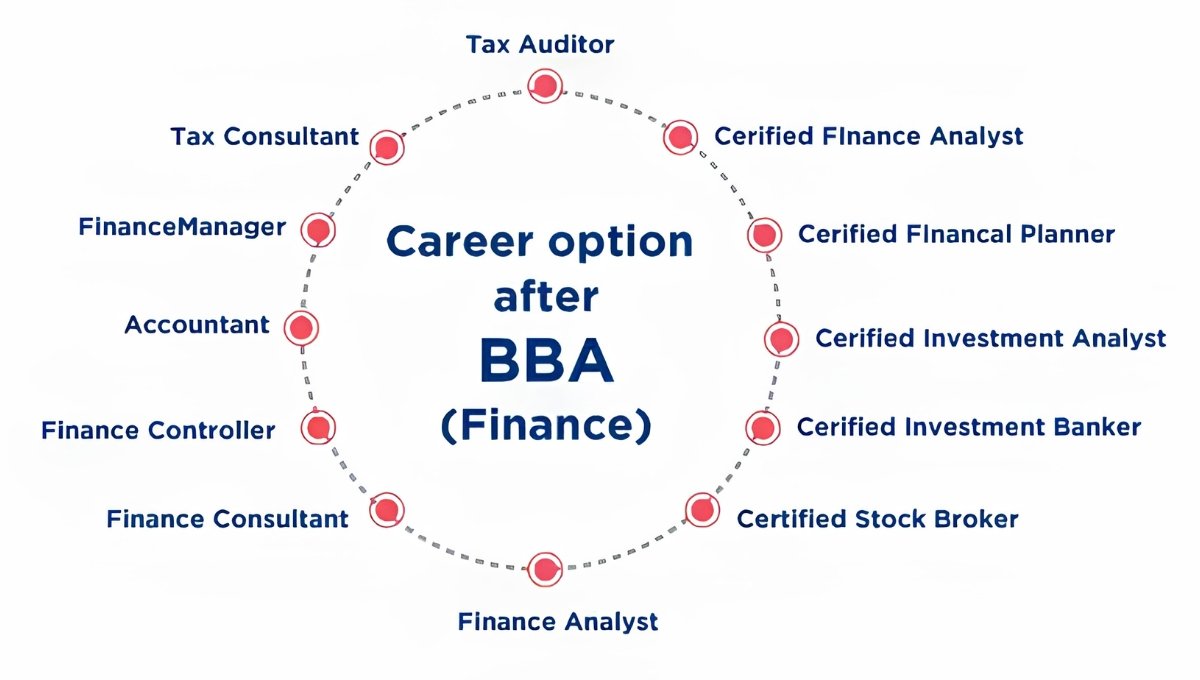
If you eventually want to enter more specialized finance roles, professional certifications or postgraduate education may be useful depending on the job.
Banking is another popular career choice.
A BBA graduate already has exposure to business, finance, economics and management, which can provide a useful foundation for banking-related careers.
Possible areas include:
Recruitment routes and eligibility vary between banks and examinations. Students should always read the current official notification before applying.
Banking can suit students who want a structured work environment and are comfortable with customer interaction, financial products and target-based responsibilities.
A BBA degree can also lead towards several government career paths.
Depending on the particular examination and its current eligibility rules, graduates can explore:
The important thing to understand is that BBA itself does not guarantee a government job. You still need to qualify through the relevant examination and selection process.
| Examination/Route | Career Area | General Graduate Eligibility |
|---|---|---|
| UPSC Civil Services | Administrative services | Yes, subject to notification |
| SSC CGL | Central government departments | Yes, subject to notification |
| State PSC | State government services | Depends on state rules |
| Banking Exams | Public-sector banking | Depends on recruitment notice |
| Insurance Exams | Insurance sector | Depends on recruitment notice |
| Railway Recruitment | Government jobs | Depends on post |
| Defence-related Exams | Defence services | Depends on exam and qualification |
The biggest challenge with government examinations is competition. You need patience, consistency and a focused preparation strategy.
If public service and administration attract you, you can consider the UPSC Civil Services Examination.
A BBA background does not prevent you from pursuing civil services. What matters is meeting the eligibility conditions and preparing effectively for the examination.
The preparation can involve subjects such as:
Your BBA background can be particularly useful when studying economics, business-related issues and aspects of public policy, although UPSC preparation requires broad knowledge across multiple areas.
The key is to understand that UPSC is a long-term commitment. Don’t start preparing simply because people tell you that “government jobs are secure.” Start because you genuinely want the career and are prepared for the competitive process.
SSC CGL is another important option for graduates interested in central government employment.
The examination recruits candidates for various posts across government departments, with the exact posts and requirements depending on the recruitment cycle.
Preparation generally requires attention to areas such as:
Always use the latest official SSC notification to confirm eligibility and examination details.
Business is becoming increasingly data-driven, and this has created opportunities for graduates who understand both business and data.
Business analytics can involve studying information to help companies make better decisions.
You can learn:
This can be an interesting combination because your BBA gives you business context while analytics gives you the technical ability to understand data.
For example, instead of simply saying that sales increased, a business analyst might investigate which region grew, which product performed best, which customer segment changed and what factors influenced the result.
Sales is sometimes misunderstood.
It isn’t simply about calling people and asking them to buy something.
Modern sales involves understanding customers, identifying opportunities, communicating value, negotiating and building relationships.
A BBA graduate can enter roles such as:
Sales can also become a strong stepping stone into management because you learn how businesses actually generate revenue.
If you are confident, energetic and comfortable talking to people, this field can offer valuable early-career experience.
Every company needs people who can make sure work gets done smoothly.
Operations professionals may deal with:
BBA graduates can begin in entry-level operations roles and later move into management positions.
An MBA in operations or supply chain management can be considered by students who want to specialize in this area.
Perhaps your dream isn’t to work for a company at all.
Maybe you want to build one.
BBA can provide a useful foundation in:
You could explore businesses such as:
But entrepreneurship comes with uncertainty.
Don’t start a business simply because you dislike having a boss. Start because you have identified a genuine problem and believe you can create something valuable to solve it.
Students sometimes assume that MCom is automatically the next step after BBA, but eligibility can vary by university and programme.
Some institutions may accept BBA graduates for relevant postgraduate commerce or management programmes, while others may specify particular undergraduate subjects or credits.
Therefore, before applying, check the exact eligibility criteria of the university.
UGC’s current framework emphasizes flexible and multidisciplinary higher education, while individual universities continue to determine programme-specific admission requirements.
Apart from MBA and MCom, you can explore several specialized programmes.
| Course | Potential Career Area |
|---|---|
| PG Diploma in Management | Management |
| Digital Marketing Certification | Digital marketing |
| Business Analytics | Data and business intelligence |
| Financial Analysis Course | Finance |
| Supply Chain Management | Operations |
| Human Resource Management | HR |
| Project Management | Project coordination |
| International Business | Global business |
| Entrepreneurship | Business creation |
| Financial Technology | FinTech |
| Communication/PR | Corporate communication |
| Data Analytics | Business and data roles |
The right course depends on your career goal. A short professional programme can be useful when it teaches practical skills, but don’t assume that every online certificate has the same value in the job market.
Your BBA degree gives you a foundation, but employers also want evidence that you can actually work.
Important skills include:
Internships are especially valuable because they expose students to real workplace situations. UGC currently lists specific guidelines for undergraduate internships and research internships, reflecting the importance of connecting higher education with practical experience.
Sometimes the easiest way to decide is to stop looking at courses and start looking at yourself.
| If You Enjoy… | Career Options to Explore |
|---|---|
| Talking to people | Sales, HR, Business Development |
| Numbers | Finance, Banking, Analytics |
| Creativity | Marketing, Digital Marketing, Advertising |
| Leadership | MBA, Management |
| Technology | Business Analytics, FinTech |
| Government service | UPSC, SSC, State PSC |
| Business building | Entrepreneurship |
| Planning and organization | Operations, Project Management |
| Research | Market Research, Analytics |
| Corporate environment | MBA, Finance, Marketing, HR |
Your friend’s career doesn’t need to become your career.
One student may love finance. Another may feel alive while creating marketing campaigns. Someone else may dream of becoming a civil servant. All of those choices can be valid.
This is one of the biggest decisions after graduation.
| Factor | Start Working After BBA | Pursue MBA |
|---|---|---|
| Income | Starts earlier | Usually delayed |
| Experience | Builds immediately | Builds through internships/projects |
| Education | No additional degree initially | Advanced qualification |
| Cost | Lower immediate cost | Tuition and living expenses |
| Career Growth | Experience-driven | Can accelerate management path |
| Specialization | Through job | Through MBA specialization |
| Best For | Students ready for work | Students targeting management roles |
There is no universally correct answer.
If you already have a good job opportunity, gaining experience before pursuing an MBA can be sensible.
If you have a clear management goal and access to a strong MBA programme, higher education may be the better choice.
UGC also provides a framework supporting academic mobility and credit transfer, giving students greater flexibility in navigating higher education.
This is one of the most searched questions, but there is no single salary figure that applies to every BBA graduate.
Your compensation can depend on:
A fresh BBA graduate working in sales, HR, finance, operations or digital marketing may have a completely different compensation structure.
Instead of choosing a career only because someone promises a particular salary, look at the skills and experience the job can help you build.
Your first salary is important, but your career trajectory is even more important.
Many students lose time because they make career decisions based on pressure rather than understanding.
Try to avoid these mistakes:
The goal isn’t to make a perfect decision on day one.
The goal is to make a well-informed decision and keep improving it as you learn more about yourself.
If you’re completely confused, here’s a practical way to move forward.
Focus on understanding yourself and researching possible careers.
Choose three options that genuinely interest you.
For example:
MBA + Marketing
Government Exams + Banking
Digital Marketing + Corporate Job
Then compare their eligibility, cost, difficulty, career growth and daily work.
Start developing a practical skill.
You might choose:
At the same time, create a resume and LinkedIn profile and begin applying for internships or entry-level roles where appropriate.
By this point, you should have a clearer direction.
You can either continue working, intensify competitive-exam preparation, prepare for MBA entrance examinations or build a specialized career skill.
The goal is simple:
Don’t spend an entire year doing nothing because you are afraid of choosing the wrong path.
Movement creates clarity.
| Career | Further Study Needed? | Difficulty | Growth Potential | Suitable For |
|---|---|---|---|---|
| MBA | Yes | Moderate to high | High | Management aspirants |
| Marketing | Not always | Moderate | High | Creative/business-minded students |
| HR | Not always | Moderate | High | People-oriented students |
| Finance | Often helpful | Moderate to high | High | Analytical students |
| Banking | Exam/recruitment route | Competitive | High | Finance-oriented graduates |
| Government Jobs | Competitive exam | High | Strong | Stability-focused aspirants |
| Business Analytics | Specialized skills | Moderate | High | Data-oriented students |
| Digital Marketing | Skill-based | Moderate | High | Digital/creative students |
| Sales | No mandatory higher degree | Moderate | High | Strong communicators |
| Operations | Experience/MBA helpful | Moderate | High | Organized problem-solvers |
| Entrepreneurship | No fixed qualification | High uncertainty | Potentially high | Business-minded students |
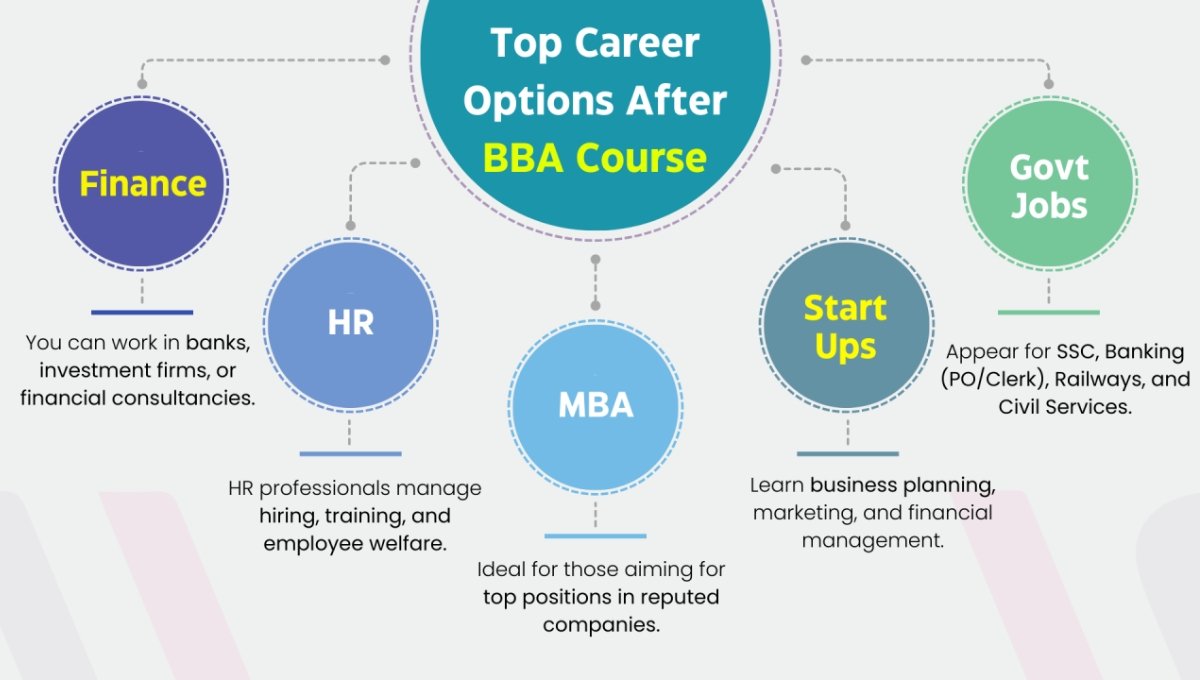
Finishing BBA can feel like standing at a crossroads. There are so many roads ahead that choosing one can feel harder than you expected. But remember something important: you don’t have to figure out your entire life immediately after graduation. Your BBA can take you toward management, marketing, finance, HR, banking, business analytics, operations, government services, digital marketing, sales or entrepreneurship. You can pursue an MBA. You can start working. You can prepare for competitive examinations. You can learn a specialised skill. You can even change direction later.
The UGC’s current approach to higher education emphasises flexibility, multidisciplinary learning and greater academic mobility, which reflects a broader shift away from the idea that students must follow one rigid educational path from beginning to end. What matters most is that you don’t choose your next step because of pressure from friends, relatives or social media. Choose it because it makes sense for you.
If you love people and communication, explore HR, sales or marketing. If you enjoy numbers and analysis, finance or business analytics may suit you. If you dream of running a company, learn entrepreneurship. If public service attracts you, explore government examinations. If you want to become a corporate leader, consider a strong MBA programme.
And whatever path you choose, keep building practical skills. Your BBA certificate tells the world what you studied. Your skills, experience, attitude and results show the world what you can actually do. That is where your real career begins.
Disclaimer: This article is intended for general educational and career-planning purposes. Course eligibility, admission procedures, examination patterns, fees, recruitment rules, professional requirements and career opportunities can change over time. Eligibility for MBA programmes, government examinations, banking recruitment and postgraduate courses can also vary between institutions and recruitment cycles.
Students should always verify the latest information through the official website or notification of the relevant university, examination authority, government department or professional body before applying. UGC regularly publishes updated regulations and guidelines for higher education, including its current 2025 minimum-standards regulations and other academic frameworks.
Salary figures should also not be treated as guaranteed. Actual earnings depend on qualifications, skills, employer, location, experience, industry and individual performance. A career decision should be made after considering your interests, abilities, financial circumstances and long-term goals rather than relying on unofficial promises or generalized salary claims.