By Viraj • September 4, 2026
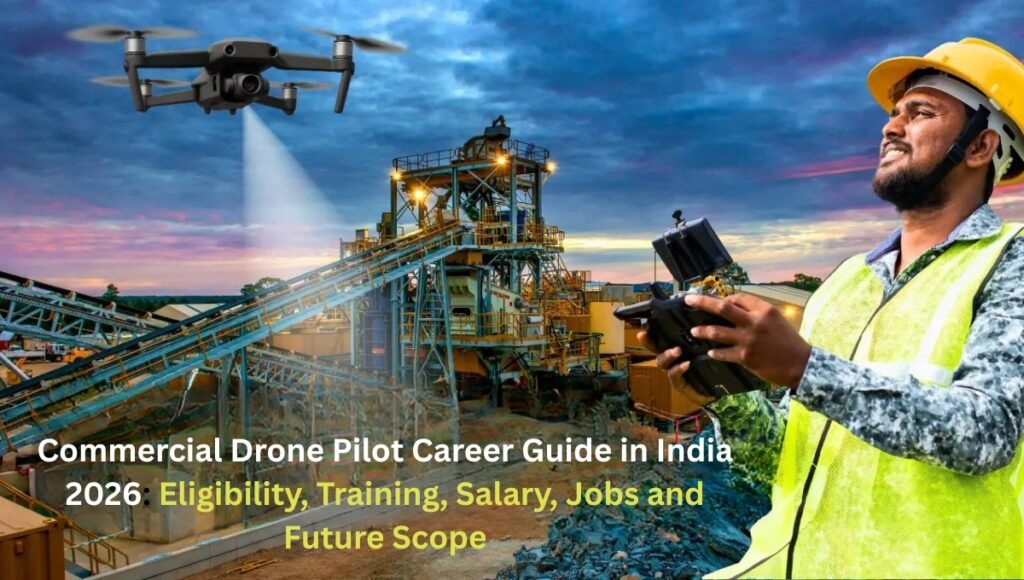
Commercial Drone Pilot Career Guide in India: A few years ago, most people looked at drones as exciting gadgets used for photography, entertainment or hobbies. Today, the picture is completely different. Drones are flying over farms, construction sites, highways, power infrastructure and survey locations, collecting information, monitoring assets and performing tasks that were once expensive, slow or difficult to complete.
This change has created a new kind of career opportunity for people who enjoy technology, aviation and practical fieldwork. A commercial drone pilot is no longer simply someone who knows how to operate a remote controller. Professional pilots are increasingly expected to understand flight planning, safety, regulations, equipment, sensors, data collection and the specific industry in which the drone is being used.
India’s drone ecosystem has grown rapidly. A Government of India backgrounder published in February 2026 reported more than 38,500 registered drones, 39,890 DGCA-certified remote pilots and 244 approved training organisations at that time. The same government information highlighted large-scale drone use in areas such as land surveys and agriculture.
That growth is opening doors for trained professionals across agriculture, surveying, mapping, infrastructure inspection, construction, media and other industries. Current job listings also show commercial drone roles involving agricultural spraying, crop monitoring, industrial inspection, infrastructure mapping, surveying and other specialised operations.
If you are thinking about becoming a commercial drone pilot, this guide will help you understand the career from the ground up, including training, eligibility, certification, skills, jobs, salary, specialisations, and future opportunities.
A commercial drone pilot is a trained professional who operates an unmanned aircraft for business, industrial, government or other professional purposes. The word “commercial” is important because the work is generally connected to a business or professional assignment rather than simply flying a drone for recreation. A commercial pilot may be asked to capture aerial photographs, survey land, monitor crops, inspect infrastructure, collect mapping data, document construction progress or support other specialised operations.
The pilot is responsible for much more than controlling the aircraft. Mission planning, equipment checks, weather assessment, safe operation, battery management, flight logs and post-flight procedures can all become part of the job. Modern employers are increasingly looking for pilots who can combine flying skills with technical knowledge. A current India-based drone pilot vacancy, for example, describes responsibilities ranging from agricultural spraying and multispectral mapping to infrastructure inspection, construction monitoring, surveying and compliance with DGCA and Digital Sky requirements.
The biggest reason is simple: drones are solving real business problems. A drone can collect aerial information quickly across large areas. In agriculture, it can support crop monitoring and precision spraying. In construction, it can document site progress. In surveying, it can capture aerial imagery for mapping. In infrastructure, it can help inspect difficult-to-access assets.
Government programs have also contributed to wider adoption. According to the Government of India, drones have already been used to survey 3.28 lakh villages under the SVAMITVA Scheme, with property cards prepared for millions of properties. The government also reported the distribution of drones to women self-help groups through initiatives including Namo Drone Didi.
This demonstrates that drone technology is no longer limited to a small group of hobbyists.
| Career Factor | Details |
|---|---|
| Career Name | Commercial Drone Pilot |
| Main Work | Professional drone operation |
| Major Sectors | Agriculture, surveying, construction, infrastructure, media |
| Core Skill | Safe and accurate drone operation |
| Important Knowledge | Regulations, airspace, weather and flight planning |
| Technical Skills | Drone systems, batteries, payloads and maintenance |
| Additional Skills | GIS, surveying, photography, data processing |
| Work Style | Field-based, project-based or full-time |
| Certification | Relevant DGCA pathway where applicable |
| Growth Potential | Higher with specialisation and experience |
The exact regulatory process depends on the drone category and the rules applicable to the operation, so you should always check the latest DGCA requirements before starting.
For someone pursuing a professional pathway, the usual starting point is understanding the applicable remote-pilot requirements and completing prescribed training through an authorised Remote Pilot Training Organisation, or RPTO.
DGCA’s training framework covers both theoretical knowledge and practical flying. Its published syllabus includes air law, Drone Rules, airspace, principles of flight, ATC procedures, meteorology, crew resource management, maintenance, risk assessment, emergency procedures, payload operations and drone data analysis.
The idea is to produce a pilot who understands the complete operation rather than someone who simply knows how to make a drone fly.
Eligibility requirements can change as India’s regulatory framework develops, so candidates should verify the current DGCA rules and the specific training pathway before admission.
Historically, the Drone Rules framework included requirements relating to age, education and prescribed training for remote-pilot licensing. DGCA’s earlier guidance material specified that a remote pilot should be at least 18 years old and have passed at least the 10th examination in English.
Because requirements can be updated, do not rely on an old eligibility table circulated online.
| Eligibility Area | What You Should Do |
|---|---|
| Age | Check the latest DGCA requirement |
| Education | Verify current minimum qualification |
| Training | Complete prescribed training where applicable |
| Medical Requirements | Check requirements for your pathway |
| Documentation | Keep identity and education documents ready |
| Certification | Follow the current official process |
An RPTO is a Remote Pilot Training Organisation authorised to provide prescribed drone pilot training.
This is an important distinction because the market contains many organisations offering general drone workshops and private certificates. A private certificate should not automatically be treated as equivalent to a regulatory credential.
DGCA’s framework provides for Remote Pilot Certificates through the applicable authorised training and certification process. Earlier DGCA training documentation states that an RPTO issues a Remote Pilot Certificate to a student who completes its approved remote-pilot training course. Before joining an institute, verify its current authorisation and approved scope through official DGCA information.
Professional drone training normally covers both theoretical knowledge and hands-on flying. The theory helps you understand how the aircraft works and how it should be operated. You learn about airspace, aviation rules, flight principles, weather and safety.
Practical training then allows you to apply that knowledge.
A good pilot should know how to conduct pre-flight checks, operate the aircraft safely, monitor batteries, respond to unexpected situations and complete post-flight procedures.
DGCA’s published syllabus is broad enough to show why commercial piloting requires more knowledge than simple recreational flying. It includes emergency procedures, risk assessment, maintenance and payload operations in addition to basic flight subjects.
Flying ability is only the foundation.
Modern commercial drone work often requires pilots to understand the equipment they are operating and the purpose of the mission.
For example, an agricultural pilot may need to understand spraying systems, field conditions and crop-related requirements. A survey pilot may need knowledge of mapping, ground control and GIS. An aerial photographer needs to understand camera settings, composition and lighting.
Some of the most useful skills include:
The strongest candidates often develop one specialisation alongside their pilot qualification.
The commercial drone industry is broad, and specialisation can make a major difference to your career.
Agriculture is one of India’s most important drone applications.
Commercial drone pilots can work on crop monitoring, aerial imaging, field mapping and, where permitted and properly authorized, agricultural spraying operations.
Current agricultural drone job listings in India mention activities including field mapping, crop health monitoring, pesticide and fertilizer spraying, data collection, equipment maintenance and compliance responsibilities.
This field can be particularly attractive for people who enjoy outdoor work and want to combine technology with agriculture.
Surveying is another major career path.
Drone pilots can collect aerial imagery for land surveys, construction projects, infrastructure planning, mining and other applications.
However, the drone landing does not mean the job is finished. The collected data often needs to be processed and converted into useful maps or models.
That is why learning GIS and photogrammetry can make a drone pilot significantly more valuable.
Drones can be used to collect visual information from power lines, solar installations, industrial facilities, towers, bridges and other infrastructure.
This type of work can require more technical knowledge because the pilot may be operating around complex structures and specialized sensors.
Safety, precision and careful mission planning become especially important.
Construction companies can use drones to document site progress, capture aerial images, monitor large projects and support surveying activities.
A pilot who understands construction terminology, mapping and project workflows can have an advantage over someone who only has flight experience.
Photography remains one of the most visible commercial applications of drones.
Real-estate companies, filmmakers, tourism businesses, event organizers and advertising agencies can use aerial footage.
However, this field is often project-based and highly competitive. Strong camera skills, editing ability and a distinctive visual style can be just as important as flying ability.
The future of drone careers is increasingly connected to data. A drone may collect hundreds or thousands of images during a single mission. Someone needs to process that information and turn it into something useful. Professionals who can combine drone operations with GIS, photogrammetry, mapping and data analysis can therefore move into more specialised roles.
Salary is one of the most searched questions, but it is also one of the areas where you should be careful with online claims. There is no single salary for commercial drone pilots. A beginner working as a junior field operator may earn considerably less than an experienced pilot specialising in surveying, industrial inspection or advanced operations. Freelancers may also earn project-based income rather than a fixed salary.
A 2026 career-industry estimate places indicative drone-pilot salary bands across different specialisations from roughly ₹3 lakh to ₹12 lakh or more for many junior-to-mid career roles, with specialised senior positions potentially reaching much higher levels. These figures are market estimates rather than guaranteed salaries and can vary substantially by employer, location, skill level and specialisation.
| Career Stage | Typical Position | Income Pattern |
|---|---|---|
| Beginner | Trainee/Junior Pilot | Entry-level salary |
| 1–3 Years | Commercial Pilot | Salary or project-based |
| 3–7 Years | Senior/Specialist Pilot | Higher salary potential |
| 7+ Years | Operations/Specialist Role | Senior compensation |
| Freelancer | Independent Pilot | Per-project/day rates |
| Business Owner | Drone Services Provider | Revenue depends on clients and projects |
Do not choose drone piloting solely because somebody promises a particular salary. Your earning potential is usually influenced by the value of the problem you can solve.
Government departments are also adopting drone technology. Drone pilots and drone-related professionals can find opportunities through government projects, public-sector organisations, surveying programs, agriculture initiatives, infrastructure projects and specialised agencies.
A recent Tamil Nadu Unmanned Aerial Vehicle Corporation recruitment drive, for example, included vacancies for drone pilots, RPTO instructors, co-pilots, supervisors and other roles, demonstrating that drone-related employment is appearing within public-sector ecosystems as well.
Government opportunities can vary significantly in eligibility, recruitment process and contract structure, so candidates should always read the official recruitment notification carefully.
Commercial drone piloting does not necessarily mean working for one employer. Some experienced pilots choose freelance work or build their own drone-service businesses. You could potentially offer services such as aerial photography, construction documentation, agricultural operations, mapping or inspection, depending on your qualifications, equipment and applicable permissions. But entrepreneurship comes with additional responsibilities.
You need to find clients, maintain equipment, understand insurance and contracts where appropriate, manage travel and operating costs, comply with regulations and deliver consistent results. Buying an expensive drone is not the same thing as building a successful drone business. The business works when clients are willing to pay for the result you deliver.
These terms are sometimes used interchangeably, but they can represent different career directions.
A pilot focuses primarily on safe flight operations. An operator may have broader responsibility for missions and equipment. A technician focuses more heavily on hardware, maintenance, troubleshooting and repairs.
| Role | Primary Focus | Useful Skills |
|---|---|---|
| Drone Pilot | Flying and mission execution | Flight, safety, planning |
| Drone Operator | Complete operational workflow | Flight + equipment + documentation |
| Drone Surveyor | Survey data collection | Flight + surveying + GIS |
| Drone Technician | Hardware and maintenance | Electronics + repair |
| Drone Data Specialist | Processing aerial information | GIS + photogrammetry |
| Operations Manager | Managing drone programs | Compliance + project management |
Understanding these differences can help you choose the right training.
Your first job may not be your dream position, and that is perfectly normal. The initial goal should be to gain genuine field experience. Create a professional resume that clearly explains your certification, training, drone categories, practical experience and additional technical skills.
If you are targeting surveying, build a portfolio around mapping projects. If you want agriculture, learn about crop monitoring and agricultural workflows. If photography is your goal, create a strong visual portfolio.
Employers are increasingly looking for pilots who can perform complete missions rather than simply demonstrate basic flight control. A current India-based commercial drone recruitment listing, for example, emphasises mission planning, pre-flight and post-flight checks, flight logs, equipment health and specialised drone applications.
A specialised degree is not necessarily the only route into commercial drone work. The relevant training and certification requirements depend on the regulatory pathway and job. However, having another professional qualification can be extremely useful.
An engineering graduate can move into drone surveying or infrastructure inspection. An agriculture graduate can specialise in agricultural drone operations. A geography or GIS graduate can move toward mapping. A photographer can develop aerial cinematography services. The degree gives you industry knowledge. Drone training gives you an additional professional tool. That combination can be powerful.
The future of commercial drone careers looks increasingly multidisciplinary. he Government of India reported nearly 40,000 DGCA-certified remote pilots by February 2026 and more than 38,500 registered drones, showing the scale the ecosystem had already reached. At the same time, current commercial job descriptions show demand across agriculture, energy, utilities, infrastructure, construction, surveying, public safety and media.
This suggests that future drone professionals will need more than flying skills. They may need to understand sensors, GIS, artificial intelligence, data processing, autonomous systems, industry workflows and safety management. In simple words, the career is moving from “Can you fly a drone?” to “Can you use a drone to solve a real problem?”
Start with proper regulatory training and build your flying fundamentals carefully. Once you are comfortable operating the aircraft, choose a specialisation. Do not try to become an expert in everything at once. If you choose surveying, learn GIS and mapping. If you choose agriculture, learn agricultural applications. If you choose photography, master cameras and editing. If you choose inspections, learn the relevant infrastructure and reporting requirements.
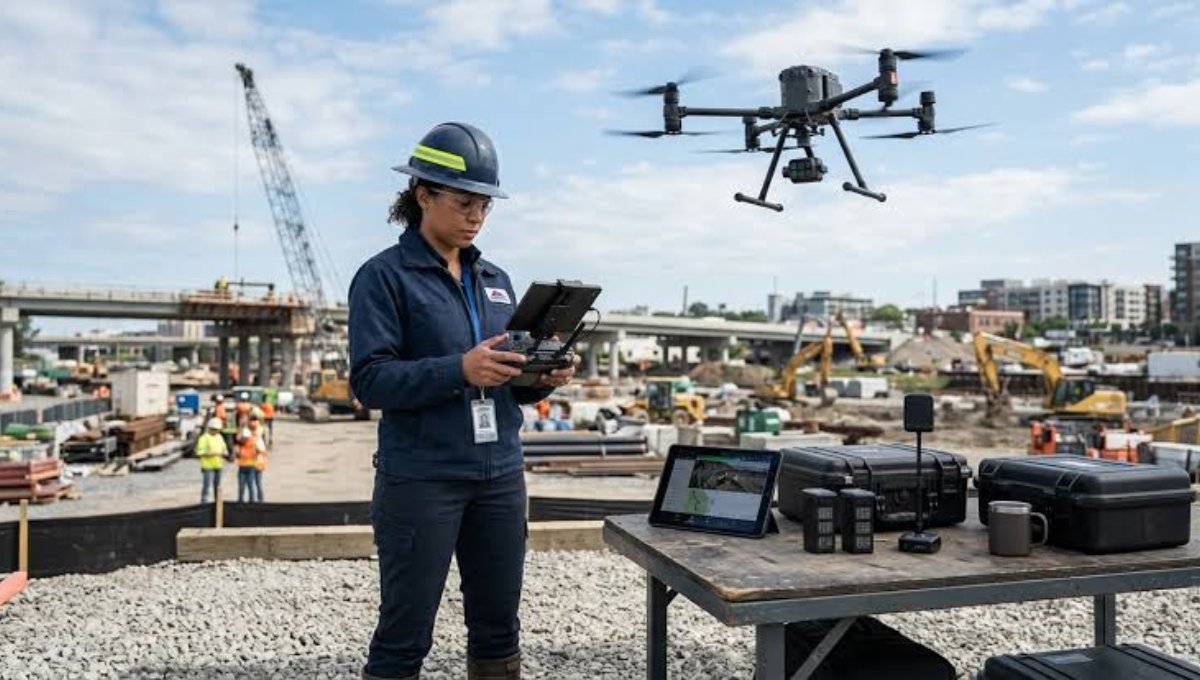
Keep records of your projects and flying experience. Build a portfolio wherever possible. Most importantly, keep learning. Drone technology changes quickly, and the professionals who continue developing their skills are more likely to remain useful as aircraft, sensors and software evolve.
Disclaimer: This article is intended for general educational and career-planning purposes only. Drone regulations, Remote Pilot Certificate requirements, eligibility criteria, training procedures, operational permissions and certification processes can change. Readers should verify the latest requirements directly with DGCA and other relevant authorities before enrolling in training or beginning commercial drone operations. Salary figures and career estimates mentioned in this article are indicative and are not guaranteed. Actual income depends on experience, specialisation, location, employer, equipment, project type, business ability and market conditions. Completing drone training or obtaining a certification does not guarantee employment, a specific salary or business success.