By Viraj • September 18, 2026
MBA Syllabus: Starting an MBA can feel exciting and a little overwhelming at the same time. You know that the degree can help you build a career in management, finance, marketing, human resources, consulting, analytics or entrepreneurship, but one question often comes first: What exactly will I study during an MBA?
The answer depends on the university and specialisation, but most MBA programmes follow a similar structure. Students generally begin with foundational management subjects and gradually move towards advanced topics, electives, practical projects and specialisations.
For MBA 2026, the syllabus is also becoming more closely connected with technology, data, artificial intelligence, sustainability and digital business. For example, current MBA curricula at leading institutions include subjects ranging from accounting, economics and marketing to business analytics, information technology, AI and responsible business.
An MBA is therefore not simply about learning how to manage people. It is about understanding how an organisation works, how decisions are made, how markets behave, how money moves through a business and how technology can be used to create better outcomes.
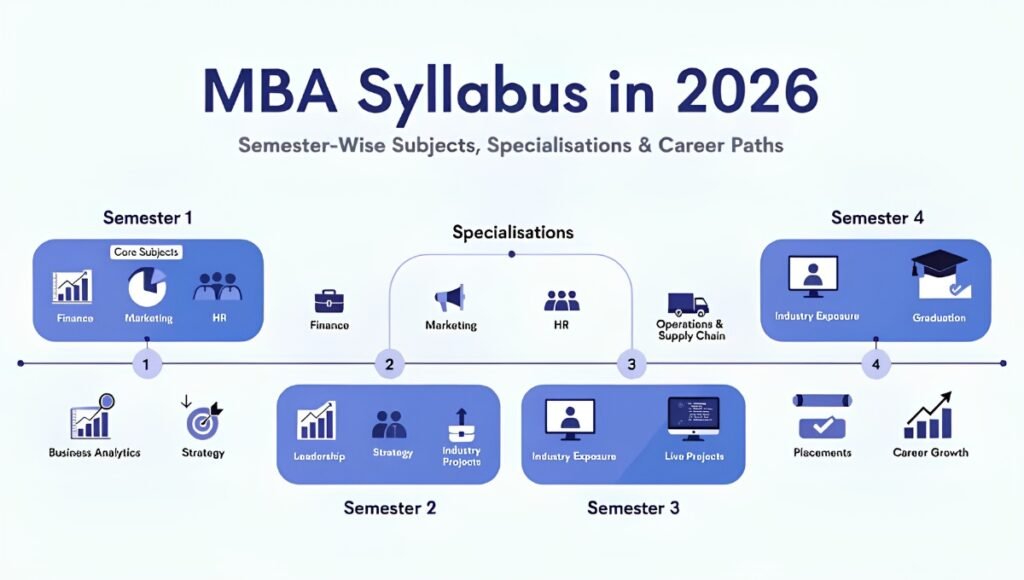
The MBA syllabus is the collection of subjects, courses, projects and practical learning activities that students complete during their management programme. Most traditional MBA programmes are structured over two years and four semesters, although the exact structure, number of credits and subjects differ between universities. For example, a current 2026 MBA syllabus from Central University of Andhra Pradesh shows four semesters with a total of 96 credits.

The first part of an MBA usually focuses on common management concepts. Later semesters allow students to choose electives or specialisations according to their interests and career plans. IIM Ahmedabad, for example, describes its programme around foundational areas such as accounting, finance, marketing and organisational behaviour, along with quantitative methods, operations, HR, strategy, technology and other business subjects.
| Semester | Main Focus | Typical Subjects |
|---|---|---|
| Semester 1 | Management Foundation | Marketing, Accounting, Economics, Statistics, HR, Operations |
| Semester 2 | Core Business Knowledge | Finance, Business Analytics, Operations, Economics, Communication |
| Semester 3 | Advanced & Specialisation Learning | Electives, Strategy, Analytics, Finance, Marketing, HR |
| Semester 4 | Application & Specialisation | Advanced electives, projects, internship/capstone |
The exact subjects can change according to the university. Some business schools use a trimester system rather than four traditional semesters.
The first semester is designed to help students understand the basic language of business.
Students generally study subjects related to accounting, economics, marketing, finance, organisational behaviour, statistics and operations.
For example, the current MBA programme structure at SIBM Hyderabad includes Business Statistics, Financial Management, Human Resource Management, Marketing Management, Operations Management, Business Analytics, Financial Accounting, Entrepreneurship and Principles and Practices of Management in the first semester.
These subjects may look different from what students studied during graduation, but they provide the foundation for advanced management education.
The second semester generally takes students deeper into different business functions.
Students may study subjects such as corporate finance, managerial economics, business research, operations, human resources, marketing strategy and information systems.
At many universities, students also begin developing a stronger understanding of how different departments work together.
This is an important stage because business decisions rarely belong to only one department. A marketing decision can affect finance, operations and customer service, while a technology decision can influence the entire organisation.
The third semester is usually where the MBA becomes more specialised.
Students may begin choosing electives according to their preferred career direction. Someone interested in finance may select investment or financial management subjects, while a marketing student may choose digital marketing, consumer behaviour or brand management.
Students interested in analytics may move towards data visualisation, predictive analytics and business intelligence.
This structure is visible in leading management programmes. IIM Bangalore, for example, combines compulsory core courses with electives, allowing students to select from multidisciplinary subjects as they progress through the programme.
The fourth semester is generally focused on advanced learning, electives and practical application.
Depending on the university, students may complete a major project, dissertation, internship, industry project or capstone assignment.
The purpose is to connect classroom learning with real business problems.
Students may have to analyse a company, conduct market research, develop a business strategy, work with data or solve a practical organisational problem.
This experience can be particularly valuable when students begin searching for jobs after graduation.
Although the exact syllabus varies, several subjects appear frequently across MBA programmes.
| Subject | What Students Learn |
|---|---|
| Marketing Management | Markets, customers, branding, pricing and promotion |
| Financial Management | Financial decisions, investment and capital |
| Financial Accounting | Financial statements and accounting principles |
| Human Resource Management | Recruitment, employee development and workplace management |
| Operations Management | Production, processes, quality and efficiency |
| Business Analytics | Data-based business decision-making |
| Managerial Economics | Economic concepts used in management |
| Business Statistics | Data interpretation and quantitative analysis |
| Organisational Behaviour | People, leadership and workplace behaviour |
| Strategic Management | Long-term business planning and competitive strategy |
| Business Communication | Presentations, writing and professional communication |
| Entrepreneurship | Business creation, innovation and startup management |
These subjects create the foundation from which students can develop specialised knowledge.
Marketing is one of the most popular MBA specialisations.
The syllabus can cover consumer behaviour, market research, product management, pricing, advertising, sales, branding and distribution.
With digital business becoming increasingly important, students may also encounter digital marketing, social media marketing, marketing analytics and e-commerce.
The subject is not simply about advertising. Students learn how businesses understand customers and create value for them.
Finance is another major part of the MBA syllabus.
Students learn how companies manage money, evaluate investments, understand financial statements and make financial decisions.
Topics can include corporate finance, financial reporting, cost management, investment analysis, capital budgeting and financial markets.
IIM Calcutta’s current MBA curriculum includes corporate financial reporting and analysis, cost management and corporate finance among its first-year finance and control courses.
Human Resource Management focuses on the people side of an organisation.
Students learn about recruitment, employee motivation, performance management, organisational behaviour, training and development, compensation and workplace relationships.
Leadership and team management are also important parts of HR and organisational behaviour education.
Operations is about how organisations produce goods or deliver services efficiently.
The syllabus can include production management, quality management, supply chain, logistics, inventory, process improvement and operations strategy.
Students interested in manufacturing, logistics, consulting or supply chain careers may find these subjects particularly useful.
Data has become an important part of modern management education.
MBA students increasingly learn how data can support business decisions. Depending on the programme, the syllabus may include statistics, data analysis, business intelligence, data visualisation and predictive analytics.
Some newer MBA programmes are also incorporating artificial intelligence and machine learning. IIM Mumbai’s current MBA curriculum, for example, includes Data Science for Managerial Decisions and Applications of AI & ML Techniques.
This reflects the growing connection between management and technology.
Strategic Management teaches students how organisations make long-term decisions.
Students may study competitive advantage, business models, corporate strategy, industry analysis and strategic implementation.
The subject encourages students to look beyond individual departments and understand the organisation as a complete system.
Entrepreneurship is particularly valuable for students who dream of building their own company.
The syllabus can introduce business models, opportunity identification, innovation, startup finance, market validation and business planning.
Even students who do not plan to become entrepreneurs can benefit because entrepreneurial thinking encourages creativity, problem-solving and calculated decision-making.
MBA specialisations allow students to develop deeper knowledge in a particular business area.
| Specialisation | Common Subjects |
|---|---|
| MBA Finance | Corporate Finance, Investment Management, Financial Analysis |
| MBA Marketing | Consumer Behaviour, Brand Management, Digital Marketing |
| MBA HR | Talent Management, Recruitment, Performance Management |
| MBA Operations | Supply Chain, Quality Management, Logistics |
| MBA Business Analytics | Data Analytics, Business Intelligence, Predictive Analytics |
| MBA International Business | International Trade, Global Strategy |
| MBA IT Management | Technology Management, Information Systems |
| MBA Entrepreneurship | Innovation, Startup Management, Venture Planning |
The exact subjects vary between universities.
Students sometimes confuse the MBA course syllabus with the syllabus of MBA entrance examinations.
They are different.
The MBA course syllabus refers to what you study after admission. Entrance exams such as CAT, XAT, CMAT, MAT and others have separate examination syllabi covering areas such as quantitative aptitude, logical reasoning, data interpretation and verbal ability.
Therefore, a student preparing for MBA admission needs to understand both the entrance examination syllabus and the actual MBA curriculum.
Modern MBA education is not limited to textbooks and written examinations. Leading business schools use case studies, classroom discussions, industry interactions, projects, simulations, presentations, business games and other experiential methods. IIM Bangalore explicitly lists case analyses, projects, simulations, role plays, business games and industry interactions among its teaching methods. This practical approach helps students understand what business decisions look like in the real world.
Internships and projects can become an important part of the MBA journey. A summer internship allows students to experience professional work and apply concepts learned during the first year. IIM Calcutta, for example, states that its students undertake summer training of up to ten weeks at the managerial level after completing first-year requirements. Depending on the university, students may also complete a final project or capstone during the later part of the programme.
A well-designed MBA syllabus develops more than subject knowledge. Finance subjects can help students understand business numbers. Marketing can develop customer and market understanding. Operations can build process and efficiency skills, while HR can develop knowledge about people and organisations. Analytics and technology subjects can help students understand modern data-driven business environments.

Communication, presentations, projects and case studies can further develop professional confidence. This combination is what makes an MBA different from simply studying one business subject in isolation.
Disclaimer: This article is intended for general educational purposes. The MBA syllabus, subjects, credits, examination pattern, electives, internships and specialisations can differ between universities and may be revised for the 2026 academic session. Students should check the latest official syllabus published by their chosen university or business school before making admission or academic decisions. The subjects discussed above represent common MBA curriculum areas and should not be treated as the exact syllabus of every institution.