By Viraj • September 4, 2026
Best Drone Pilot Courses In India: There was a time when seeing a drone flying in the sky felt like watching something from the future. Today, drones have become a real part of everyday business. They are being used for aerial photography, filmmaking, agriculture, surveying, mapping, construction, infrastructure inspection, disaster management, logistics and several other professional applications.
As the use of drones grows, so does the need for trained people who know how to operate them safely and professionally. This has created an exciting career opportunity for students, graduates, photographers, engineers, surveyors and even working professionals who want to learn a new skill.
If you enjoy technology, flying machines and outdoor work, becoming a drone pilot can be an interesting career path. But there is an important difference between simply knowing how to fly a drone and being professionally trained as a remote pilot.
In India, drone training is connected to the regulatory framework of the Directorate General of Civil Aviation, or DGCA. DGCA maintains an approved ecosystem for Remote Pilot Training Organisations, commonly called RPTOs. Its current dashboard shows hundreds of RPTO approvals, demonstrating how quickly the professional drone-training ecosystem has developed.
So, if you are searching for the best drone pilot courses in India, the first thing to understand is not just the course name. You need to know about DGCA requirements, eligibility, practical flying training, course duration, fees, career opportunities and the kind of drone work you want to pursue.
This guide explains everything in simple language so that you can make a more informed decision.
A drone pilot course is a professional training program designed to teach students how to operate unmanned aircraft systems safely and effectively. A proper professional course generally combines classroom learning with practical flying. The theoretical part can cover subjects such as aviation regulations, airspace, weather, drone systems, flight principles, safety procedures and emergency operations. The practical component is equally important. Students need to understand how to control a drone, plan a flight, respond to unexpected situations and operate the aircraft responsibly.
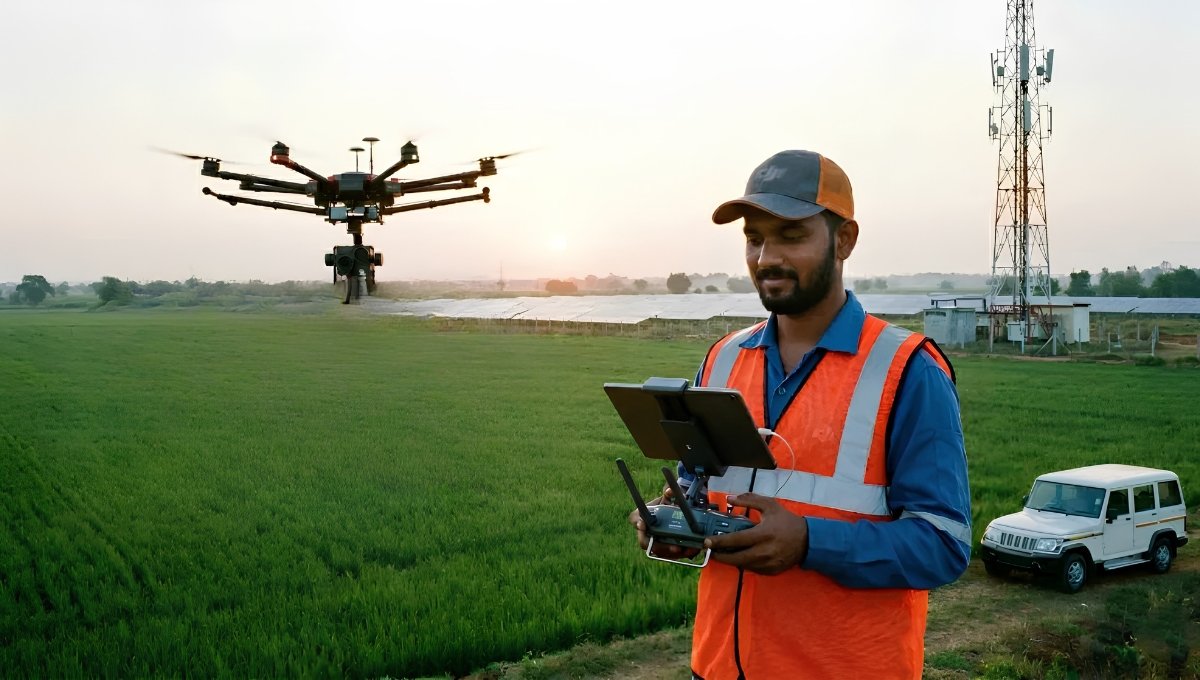
DGCA’s published remote-pilot training syllabus includes areas such as air law, the Drone Rules, airspace, principles of flight, ATC procedures, aerodynamics, meteorology, crew resource management, instrument flying, weight and balance, drone maintenance, risk assessment, emergency procedures, payload use and drone data analysis. This means a serious drone pilot course is much more than learning which joystick makes the drone move forward.
India’s drone industry has expanded into many areas. Government departments, infrastructure companies, agriculture businesses, survey organisations, construction companies, media houses and technology firms are increasingly using drones for specialized work.
The appeal of drone careers is also connected to the relatively short training pathway compared with many traditional professional careers.
A student does not necessarily need to spend several years completing a specialized degree before learning the fundamentals of professional drone operations. However, the exact qualification required depends on the type of drone operation, role and regulatory requirements applicable at the time.
For someone already working in surveying, photography, agriculture, construction or GIS, drone training can also become an additional professional skill rather than a completely new career.
There is no single course that is best for everyone. Your ideal program depends on whether you want to become a certified remote pilot, work in drone surveying, enter agriculture, pursue aerial photography or eventually specialize in advanced drone operations.
| Course Type | Main Focus | Suitable For | Typical Career Direction |
|---|---|---|---|
| DGCA-authorised Remote Pilot Training | Safe professional drone operation | Beginners and aspiring pilots | Remote Pilot |
| Drone Survey & Mapping | Mapping, surveying, data collection | Engineers, surveyors, GIS students | Drone Surveyor |
| Drone Photography & Videography | Aerial imaging and camera operation | Photographers, creators | Aerial Photographer |
| Agricultural Drone Training | Crop spraying and farm applications | Agriculture professionals | Agri-drone Operator |
| Drone GIS & Data Processing | Mapping and geospatial analysis | GIS and engineering students | Drone Mapping Specialist |
| Advanced Drone Operations | Specialised professional applications | Experienced pilots | Advanced Drone Professional |
| Drone Maintenance & Repair | Hardware and troubleshooting | Technical learners | Drone Technician |
Among these, students who specifically want a regulated professional remote-pilot pathway should pay particular attention to training from a DGCA-authorised RPTO and the applicable current rules.
DGCA plays a central role in India’s civil aviation regulation, including the regulatory framework for drones. The DGCA maintains an approved RPTO ecosystem. An RPTO is a Remote Pilot Training Organisation authorised to provide prescribed remote-pilot training. The DGCA’s current public dashboard, updated in September 2026, shows 282 RPTO approvals in total, with approvals recorded across 2023, 2024, 2025 and 2026.
This is useful information for students because it means you have multiple training options, but it also creates another challenge: you must carefully verify the organisation and its current approved scope before enrolling. The DGCA website provides an RPTO approved-scope facility, which should be checked before making a payment to a training provider.
Eligibility can depend on the specific certification and applicable regulations. Under the original Drone Rules framework, eligibility for a remote pilot licence included being at least 18 years old, having passed Class 10 or an equivalent examination and completing prescribed training from an authorised remote pilot training organisation.
Because aviation and drone regulations can be updated, students should always check the latest DGCA requirements before admission rather than relying on an old advertisement or social-media post.
| Eligibility Factor | General Consideration |
|---|---|
| Education | Class 10 or equivalent has been specified under the Drone Rules framework |
| Age | 18+ under the cited Drone Rules framework |
| Training | Prescribed training from an authorized organization |
| Practical Skills | Required for professional operation |
| Regulatory Knowledge | Essential |
| Medical/Other Requirements | May depend on applicable licence/certificate and rules |
The exact requirements for the credential you are pursuing should always be confirmed through the latest DGCA notification and the training organization’s approved scope.
A professional course usually begins with the fundamentals. You learn how drones work, how different components interact and how aircraft respond to control inputs. From there, training moves into aviation rules, airspace restrictions and flight safety.
Weather is another important part of training. Wind, rain, visibility and other meteorological conditions can directly affect a drone’s performance. Students also learn emergency procedures. What happens if the drone loses communication? What if the battery becomes critically low? How should a pilot respond if an unexpected obstacle appears?
These are not theoretical questions. A professional pilot must be prepared for situations where things do not go according to plan. DGCA’s published syllabus specifically includes safety management, risk assessment, emergency procedures, maintenance and payload-related knowledge alongside flight fundamentals.
Drone pilot course duration can vary depending on the training provider, drone category, certification pathway and specialisation. Short introductory programs may last only a few days, while more comprehensive professional programs can extend over several weeks.
A specialised course in drone mapping, agriculture or data processing can take additional time because students are learning more than basic flight control.
| Course | Approximate Nature of Training |
|---|---|
| Basic Drone Familiarisation | Short-term |
| Professional Remote Pilot Training | Structured theory + practical training |
| Drone Survey Course | Remote pilot skills + surveying |
| Drone Mapping Course | Flight + GIS + data processing |
| Agricultural Drone Course | Flight + agricultural application |
| Drone Photography Course | Flight + camera + editing |
| Advanced Professional Program | Extended technical and operational training |
These are broad categories rather than fixed national durations. Always verify the current duration of the specific approved course before enrollment.
Course fees vary significantly depending on the institution, location, course duration, equipment, practical flying hours and specialisation. A basic recreational workshop can be relatively inexpensive, while professional training involving regulated certification, aircraft, instructors, practical flying and specialised software can cost considerably more. You should not choose a course simply because it is the cheapest option.
A low-cost course with very little practical flying may not provide the confidence or experience required for professional work. On the other hand, an expensive course is not automatically better.
Before paying, compare what is included in the fee.
| Fee Component | What to Check |
|---|---|
| Training Fee | Total tuition amount |
| Practical Flying | Number of flying sessions/hours |
| Drone Equipment | Whether aircraft are provided |
| Examination | Included or charged separately |
| Certification | What credential is actually issued |
| Accommodation | Required for outstation students |
| Software Training | Included for mapping/GIS courses |
| Additional Charges | Registration, materials or other fees |
Always ask for a written fee structure before registration.
The drone industry is much bigger than simply flying drones. One of the most promising areas is drone surveying and mapping. Drones can collect aerial imagery that can be processed to create maps, models and other useful datasets. This can support construction, mining, land surveys, infrastructure planning and engineering work.
Agriculture is another important area. Drones can support crop monitoring and, where legally permitted and appropriately authorized, agricultural spraying and other farm operations.
Aerial photography and videography is an attractive option for creative professionals. Weddings, films, advertisements, real estate and tourism can all use aerial imagery.
Infrastructure inspection is another specialised field. Drones can help capture visual information from difficult-to-reach areas, potentially reducing the need for people to physically access certain locations.
GIS and data analysis can take drone careers one step further. Instead of only flying the aircraft, professionals can learn how to process the information collected during flights and turn it into useful business or engineering insights.
Drone careers are becoming increasingly diverse. A trained professional can work as a remote pilot, drone surveyor, aerial photographer, GIS operator, agriculture drone operator, drone technician or drone data specialist, depending on their additional skills and qualifications.
| Job Role | Main Work | Useful Additional Skills |
|---|---|---|
| Drone Pilot | Professional drone operation | Flight planning, safety |
| Drone Surveyor | Land and infrastructure surveys | Surveying, GIS |
| Drone Mapping Specialist | Aerial mapping and modeling | GIS, photogrammetry |
| Aerial Photographer | Photo and video capture | Camera operation, editing |
| Agri-drone Operator | Agricultural drone applications | Agriculture, field operations |
| Drone Technician | Repair and maintenance | Electronics, troubleshooting |
| Drone Data Analyst | Processing aerial datasets | GIS, data analysis |
| Drone Operations Manager | Managing drone programs | Project management, compliance |
The most valuable professionals are often those who combine flying ability with another skill. For example, an engineer who understands surveying and drones may have a stronger professional profile than someone who only knows how to fly. Similarly, a photographer with drone skills can offer a broader service to clients.
Drone pilot salaries vary widely. There is no single fixed salary for the profession. A fresher may start at a modest level while gaining experience, whereas an experienced professional working in specialised surveying, infrastructure, industrial inspection or data-intensive projects can potentially earn more.
Freelancers can have an entirely different income structure because they may charge per project, day or assignment rather than receiving a fixed monthly salary.
| Experience Level | Potential Career Position |
|---|---|
| Beginner | Trainee/Junior Drone Operator |
| Early Career | Drone Pilot/Field Operator |
| Experienced | Senior Drone Pilot/Survey Specialist |
| Specialized | Mapping, Inspection or Data Specialist |
| Advanced | Drone Operations Manager/Consultant |
Salary depends on location, industry, technical skills, project complexity, certification, experience and employer. Therefore, online salary figures should be treated as indicative rather than guaranteed.
For the right person, yes. But it is important to understand that drone piloting is not simply about flying a machine and taking beautiful aerial videos. Professional drone operations involve responsibility. You need to understand regulations, safety, weather, equipment, airspace and emergency procedures. The career can be especially attractive for people who enjoy a combination of technology and practical fieldwork.
It can also complement existing careers. A civil engineer can add drone surveying skills. An agriculture professional can learn agricultural drone operations. A photographer can add aerial cinematography to their services. A GIS professional can specialize in drone-based mapping. That combination can be extremely valuable.
Before enrolling, verify the training provider’s current authorisation and approved scope through official DGCA resources. The DGCA itself provides information on approved RPTO scope. You should also ask how much practical flying is included. A course that spends almost all its time in a classroom may not give you enough confidence for real field operations.
Check the drones used for training as well. Modern professional work can involve different aircraft configurations, cameras, sensors and payloads, so relevant hands-on experience matters. You should also understand exactly what certificate or credential you will receive after completing the program. Do not assume that every private “drone certificate” is equivalent to a DGCA-related professional credential.
A drone pilot course and a university degree are not the same thing. A short professional course can teach you a specialised operational skill relatively quickly. A degree in engineering, computer science, agriculture, geography, surveying, GIS or another relevant field provides broader academic knowledge. For long-term career growth, the combination can be powerful.
A civil engineering graduate with drone surveying knowledge, for example, can understand both the engineering requirements and the technology used to collect aerial data. Similarly, a geography or GIS graduate who understands drone mapping can combine field data collection with spatial analysis. The future of drone careers is therefore likely to reward multidisciplinary professionals rather than people who only know how to operate a controller.
If you are starting from zero, begin by understanding the basics of drones and the regulations that govern their operation. Next, identify the type of work you want to pursue. Do you want to fly drones professionally, work in surveying, enter agriculture, create aerial videos or work with mapping data? After that, select an appropriate training program and verify its current regulatory status. Complete the required theoretical and practical training seriously rather than treating the course as a formality.
Once you have the necessary training, continue building practical skills. Learn flight planning, safety procedures and equipment handling. If you want to specialise, add GIS, surveying, photography, agriculture, data processing or another complementary skill. The final step is building experience. Small projects, internships, field assignments and a professional portfolio can help you demonstrate what you can actually do.
Disclaimer: This article is intended only for general educational and career-planning purposes. Drone regulations, licensing or certification requirements, training syllabi, approved organisations, fees and operational rules can change. The eligibility information discussed above reflects the applicable regulatory material and official DGCA resources available at the time of writing, but readers should verify the latest requirements directly with DGCA and the relevant authorised training organisation before enrolling in any course. Course durations, fees, salaries and career opportunities are indicative and can vary significantly according to location, employer, specialisation, experience and market conditions. Completing a drone pilot course does not guarantee employment or a specific salary.