By Viraj • September 2, 2026
BCom: Completing a Bachelor of Commerce (BCom) is a big milestone. You have spent years learning about accounting, business, economics, finance, taxation and management, and now comes the question that quietly worries many graduates: “What should I do next?”
The good news is that a BCom degree gives you far more choices than you may think. You can enter the corporate world, prepare for government examinations, pursue professional qualifications such as CA, CMA or CS, complete an MBA, build a career in banking and finance, work in accounting and taxation, explore digital marketing, or even start your own business.
Your BCom degree is not the end of your education. It is a foundation on which you can build a career that matches your interests and ambitions. The University Grants Commission’s current undergraduate framework also emphasises flexibility, multidisciplinary learning and allowing students to choose fields that support their career interests.
So, if you have completed BCom and are feeling confused about your next move, don’t worry. There is no single “best” career after BCom. The right choice depends on what you enjoy, what you are good at, how much time you can invest in further education and what kind of professional life you want.
This complete guide explores the major career opportunities after BCom, the courses you can pursue, government and private-sector jobs, professional qualifications, important skills, salary considerations and a practical roadmap for making your next career decision.
A BCom graduate can choose from several academic, professional and employment-oriented paths.
| Career Option | Further Qualification/Requirement | Career Area | Suitable For |
|---|---|---|---|
| Chartered Accountant | CA qualification | Accounting, audit, taxation | Finance-focused students |
| Company Secretary | CS qualification | Corporate law and compliance | Students interested in corporate regulations |
| Cost Accountant | CMA qualification | Costing and management accounting | Finance and costing enthusiasts |
| MBA | MBA/PGDM | Management and corporate jobs | Students targeting business careers |
| MCom | Postgraduate degree | Academics, finance, teaching | Students interested in higher studies |
| Banking | Competitive exams/recruitment | Banking and financial services | Students seeking banking careers |
| SSC CGL | Competitive examination | Central government jobs | Government-job aspirants |
| UPSC | Civil Services Examination | Administration and public service | Civil services aspirants |
| Financial Analyst | Relevant skills/qualification | Finance and investment | Analytical students |
| Accountant | BCom + accounting software/experience | Accounts and taxation | Accounting-oriented graduates |
| Digital Marketing | Skill-based training | Digital business | Creative and digitally inclined students |
| HR | MBA/PG qualification or entry-level experience | Human resources | People-oriented graduates |
| Business/Entrepreneurship | Business skills and capital | Entrepreneurship | Students wanting to build a business |
| Insurance | Recruitment/exams | Insurance and financial services | Finance and sales-oriented students |
| Stock Market/Investment | Relevant knowledge and certifications | Investment and markets | Market enthusiasts |
The best option is not necessarily the course with the biggest name. It is the path that gives you the right combination of interest, employability, growth and long-term satisfaction.
For students who genuinely enjoy accounting, taxation, auditing and finance, Chartered Accountancy (CA) remains one of the most prominent professional options after BCom. The Institute of Chartered Accountants of India (ICAI) provides routes for graduates to enter its professional programme.
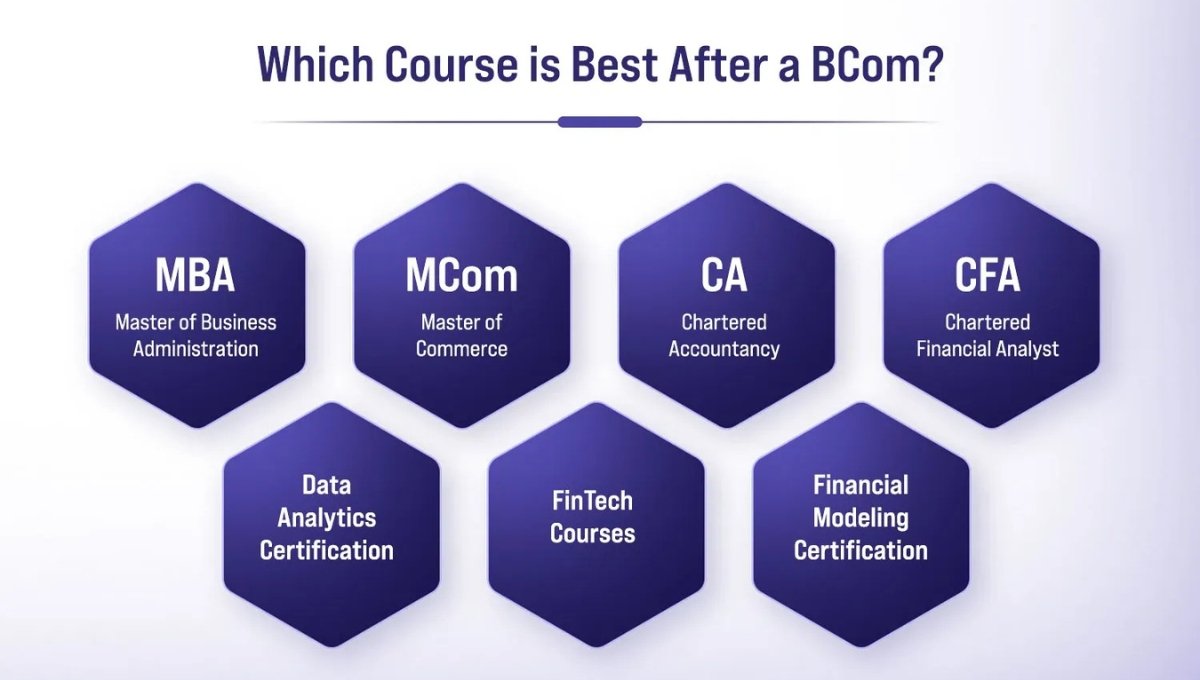
ICAI’s current educational material describes a direct-entry route in which eligible commerce graduates can enter the Intermediate level subject to the prescribed academic requirements. The CA journey involves professional examinations, practical training and other requirements prescribed by ICAI. It requires patience and consistent preparation, but it can lead to careers in accounting, audit, taxation, consulting, financial reporting and corporate finance.
If numbers don’t scare you and you genuinely enjoy understanding how businesses make and manage money, CA can be a strong career direction.
ICAI also maintains a placement platform for newly qualified CAs and publishes information about campus recruitment programmes and participating organisations.
Another professional option is Company Secretary (CS).
A CS professional works closely with corporate governance, company law, regulatory compliance and secretarial responsibilities. This makes the field particularly relevant for people who enjoy law, business rules and corporate structures.
A CS can work in:
It can be an excellent choice if you like commerce but are also interested in the legal side of business.
The Cost and Management Accountancy (CMA) route can be considered by students who are interested in costing, budgeting, financial management and business decision-making.
CMA professionals can work in areas such as:
The field is particularly useful for students who want to understand not just how much a business earns, but also how efficiently it operates.
If you want to move beyond traditional accounting and enter management, an MBA can be an attractive option.
A BCom background gives you a useful understanding of business fundamentals, while an MBA can help you specialize in a particular management function.
Popular MBA specialisations include:
| MBA Specialization | Potential Career Areas |
|---|---|
| Finance | Corporate finance, banking, financial analysis |
| Marketing | Sales, brand management, marketing |
| Human Resources | Recruitment, HR operations, talent management |
| Business Analytics | Data-driven business roles |
| Operations | Operations and supply chain |
| International Business | Global business and trade |
| Digital Marketing | Online marketing and brand growth |
| Entrepreneurship | Startups and business development |
However, don’t choose an MBA simply because you don’t know what else to do.
Before spending significant money on an MBA, compare the institution’s reputation, curriculum, fees, placement information, internship opportunities and the career outcomes relevant to your goals.
If you want to continue studying commerce academically, Master of Commerce (MCom) is the most direct postgraduate route.
MCom can help you develop deeper knowledge in areas such as:
It can be useful for students interested in academics, teaching, research, competitive examinations or specialized finance-related careers.
However, an MCom should ideally be combined with a clear career plan. A postgraduate degree by itself does not automatically guarantee a job.
Before choosing an institution, students should verify the university and programme’s recognition and current status. UGC maintains information about higher-education institutions and provides tools for students to verify institutional authenticity.
Banking is one of the most popular career choices among commerce graduates.
BCom students often already have exposure to accounting, economics, finance and business concepts, which can provide a useful foundation for banking examinations and roles.
Career opportunities can include:
Recruitment requirements vary by examination and institution. For example, current banking recruitment notices publish specific eligibility, age and application requirements, so candidates should always read the latest notification rather than relying on old eligibility information.
Banking can appeal to students who want:
Preparation usually requires a combination of quantitative aptitude, reasoning, English, general awareness and other areas specified in the particular examination.
A BCom degree also opens the door to several graduate-level government examinations.
Depending on the examination and its current eligibility requirements, BCom graduates can explore:
Government recruitment is highly competitive, so preparation should be approached as a serious long-term project rather than a backup plan chosen without research.
| Examination/Route | Broad Career Area | BCom Relevance |
|---|---|---|
| UPSC Civil Services | Administration and public services | Graduate eligibility, subject to notification |
| SSC CGL | Central government departments | Strong option for graduates |
| Banking Exams | Banking | Highly relevant |
| State PSC | State administration | Graduate-level opportunities |
| Insurance Exams | Insurance | Commerce background can help |
| Railway Recruitment | Various government roles | Depends on post |
| Government Finance Roles | Accounts and finance | Particularly relevant |
Always check the latest official notification because eligibility, age limits, examination patterns and vacancies can change.
SSC CGL is another major route for graduates looking for central government employment.
The examination can lead to different posts across government departments, depending on the specific recruitment cycle and vacancies.
A BCom graduate may find the preparation interesting because commerce education can help with some financial and economic concepts, although the examination requires preparation across multiple areas.
A typical preparation strategy may include:
The exact examination structure should always be checked in the latest SSC notification.
If you enjoy numbers but don’t want to become an accountant, you can explore financial analysis.
Financial analysts study business performance, financial statements, market information and other data to support business or investment decisions.
You can develop skills in:
Additional certifications or specialized courses can strengthen your profile depending on the role you target.
This career is particularly suitable for someone who enjoys asking questions such as:
Why did this company make more profit this year? Why are costs rising? Is this business financially healthy?
Accounting is one of the most direct career paths after BCom.
Entry-level opportunities can include:
Knowledge of accounting software and spreadsheets can significantly improve your employability.
You should consider learning tools such as:
The degree tells an employer that you studied commerce. Practical skills show the employer what you can actually do.
Taxation can be another valuable area for commerce graduates.
You can develop knowledge in:
Some professional roles require specific qualifications, registrations or experience, so students should distinguish between general tax-support jobs and regulated professional practice.
The commerce background is particularly useful because taxation is closely connected with accounting and business transactions.
For students who are ambitious about finance, investment banking and financial services can be exciting areas to explore.
Potential areas include:
These careers can be demanding and often require strong analytical ability, Excel skills, financial knowledge and excellent communication.
A BCom is a starting point, not necessarily the complete qualification required for every high-end finance role.
If you are genuinely interested in financial markets, you can explore careers related to:
However, students should be careful about confusing learning about financial markets with trying to make quick money from trading.
A professional finance career requires knowledge, discipline, ethics and an understanding of risk.
Never choose a career because someone on social media promises that you can become rich quickly through trading.
Commerce graduates don’t have to stay within accounting and finance.
Digital marketing has created career opportunities for graduates from many academic backgrounds.
You can learn:
A BCom graduate can even combine commerce knowledge with digital skills and work in e-commerce, fintech, financial content, online business and digital sales.
| Job Role | Main Responsibility |
|---|---|
| SEO Executive | Improve search visibility |
| Social Media Executive | Manage social platforms |
| Performance Marketer | Manage paid campaigns |
| Content Writer | Create online content |
| Email Marketing Executive | Manage email campaigns |
| Digital Marketing Executive | Handle multiple digital channels |
| E-commerce Executive | Support online business operations |
The best way to enter this field is to learn the tools and then build actual projects or a portfolio.
If you enjoy communicating with people more than working with spreadsheets all day, HR could be an interesting transition.
BCom graduates can explore entry-level roles in:
An MBA or postgraduate qualification in HR can help those who want to build a long-term management career in human resources.
Sales is sometimes overlooked by graduates because people think it is simply about convincing customers.
Modern sales involves much more.
You may work on:
A commerce graduate’s understanding of business can be useful here.
Sales can also become a powerful training ground for future managers because you learn how customers think, how businesses make decisions and how revenue is generated.
Not every BCom graduate needs to work for someone else.
Your commerce education can be useful if you want to start a business.
You may explore:
But entrepreneurship requires much more than knowing accounting.
You also need to understand customers, marketing, operations, cash flow, pricing and risk.
Start small, test your idea and learn before making a large financial commitment.
A degree can get your resume noticed, but practical skills can help you perform once you get the opportunity.
Internships can also make a major difference. UGC’s internship guidelines cite data showing strong student demand for internships and note the value employers place on practical experience.
So don’t wait until your final semester to think about experience.
Sometimes the easiest way to choose a career is to understand yourself first.
| If You Enjoy… | Consider These Careers |
|---|---|
| Numbers and accounts | CA, CMA, Accountant |
| Business and management | MBA, Management |
| Banking and finance | Banking, Financial Analyst |
| Law and regulations | CS, Compliance |
| Government service | UPSC, SSC, State PSC |
| Talking to people | Sales, HR |
| Creativity | Digital Marketing, Content |
| Technology | Analytics, FinTech, Digital Careers |
| Business building | Entrepreneurship |
| Research and academics | MCom, Research, Teaching |
There is no shame in choosing a career that is different from what your classmates choose.
The person sitting next to you may become a CA. Someone else may become a banker. Another person may build a successful digital business.
Your career doesn’t have to look like theirs.
This is one of the biggest decisions you will make.
| Factor | Higher Studies | Job |
|---|---|---|
| Main Advantage | Specialized knowledge | Work experience |
| Income | Usually delayed | Starts earlier |
| Investment | Tuition and time | Usually lower initial cost |
| Learning | Academic/professional | Practical |
| Best For | Professional specialization | Experience seekers |
| Career Growth | Qualification-based in some fields | Experience and performance |
| Flexibility | Depends on course | Can learn while working |
There is also no rule saying that you must make a permanent choice immediately.
You can work and later pursue further education, provided the chosen programme and institution allow it.
UGC has also issued guidelines concerning pursuing two academic programmes simultaneously, including a partial modification published in 2025. Students should check the current applicable rules and the policies of their chosen institutions before combining programmes.
This is probably one of the first questions students ask.
But there is no single salary for a BCom graduate.
Your income depends on:
An entry-level accountant and a finance analyst may have completely different compensation. A BCom graduate working in sales may have a different salary structure from someone working in banking or HR.
Instead of chasing a random salary number, look at the career’s long-term earning potential and skill growth.
A job that teaches you valuable skills today can sometimes be more useful than a slightly higher-paying job that offers little learning.
If you’re still confused, don’t sit around waiting for clarity to magically appear.
Start with a simple process.
Ask yourself:
Don’t research twenty careers at once.
Choose three realistic possibilities and compare:
While deciding your career, learn something useful.
For example:
BCom + Advanced Excel + Accounting Software
or
BCom + Financial Analysis
or
BCom + Digital Marketing
or
BCom + Data Analytics
or
BCom + Communication + Sales
Combining your degree with practical skills can make your profile more useful to employers.
| Career | Time Investment | Difficulty | Growth Potential | Best For |
|---|---|---|---|---|
| CA | High | High | Strong | Accounting and finance |
| CS | High | High | Strong | Corporate law and compliance |
| CMA | High | High | Strong | Costing and management accounting |
| MBA | 1–2+ years | Varies | Strong | Corporate management |
| MCom | Usually 2 years | Moderate | Moderate to strong | Higher studies |
| Banking | Preparation varies | Competitive | Strong | Banking aspirants |
| SSC CGL | Preparation varies | Competitive | Strong | Government-job aspirants |
| Financial Analyst | Skill-building required | Moderate | Strong | Finance-oriented students |
| Accounting | Immediate entry possible | Moderate | Experience-driven | Accounts-focused students |
| Digital Marketing | Skill-building | Moderate | Strong | Digital careers |
| HR | Skill/qualification dependent | Moderate | Strong | People-oriented students |
| Entrepreneurship | Variable | High uncertainty | Potentially very high | Business-minded students |
Completing BCom can feel like standing at a crossroads. One road leads toward CA, CS or CMA. Another takes you toward an MBA or MCom. There are government examinations, banking careers, accounting and taxation, financial analysis, HR, sales, digital marketing and entrepreneurship.
That can feel overwhelming, but it is also your biggest advantage.
You have choices.
Don’t choose a career because somebody told you that it is “the best career after BCom.” There is no universal answer.
If you love accounting, explore CA, CMA or accounting and finance. If you enjoy corporate management, consider an MBA. If stability and public service attract you, explore government examinations. If you enjoy finance and analysis, build financial-analysis skills. If you are creative and comfortable with technology, digital marketing may be worth exploring. If you dream of building something of your own, entrepreneurship could be your direction. Most importantly, don’t underestimate practical skills.
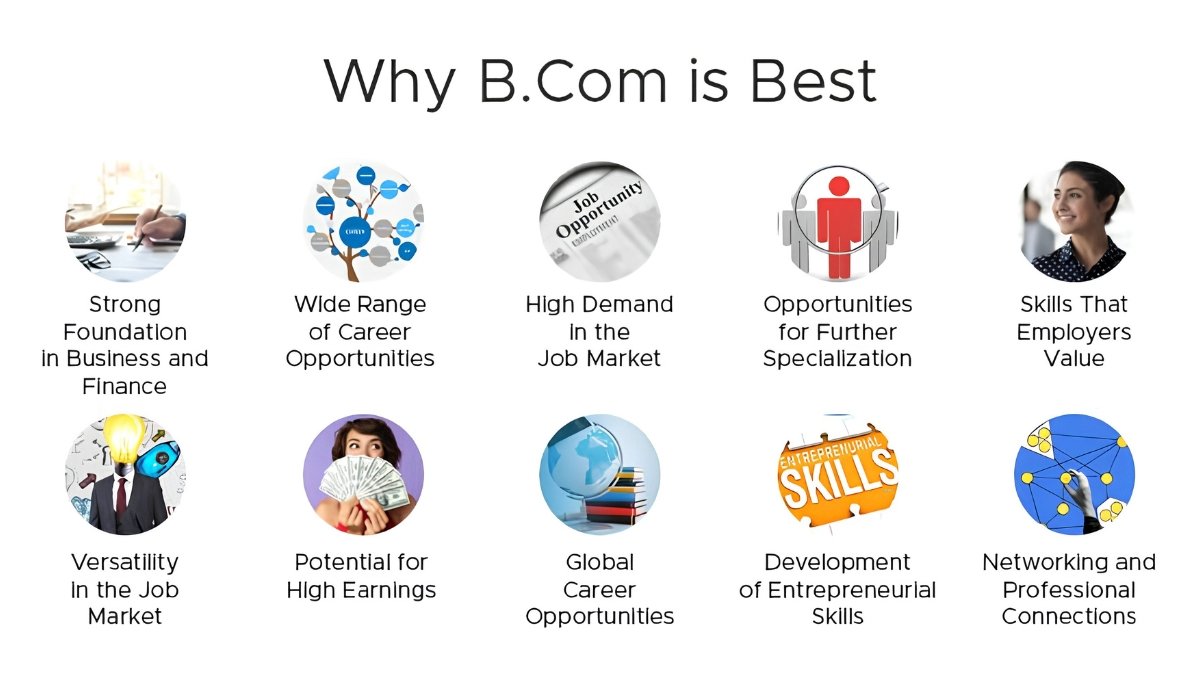
Your BCom degree gives you the foundation. Your skills, internships, projects, professional qualifications, communication and real-world experience can determine how effectively you use that foundation.
And if you haven’t figured everything out yet, that’s okay. You don’t need to have your entire career mapped out at 21 or 22. You just need to make your next smart move.
Disclaimer: This article is intended for general educational and career-planning purposes only. Course structures, eligibility requirements, examination patterns, age limits, fees, recruitment rules, professional-course regulations and career opportunities may change over time. The eligibility mentioned for CA, banking, government examinations and other professional routes should not be treated as a permanent rule. Candidates should always check the latest official notification or website of the relevant authority before applying.
Students should also verify whether a university, college or programme is recognised and whether its qualification is suitable for their intended career. UGC provides official information on higher-education institutions and regulations, while professional bodies such as ICAI publish their own current course and eligibility requirements.
A career decision should be based on your individual interests, skills, financial circumstances and long-term goals rather than salary claims or promises made by unofficial sources.
