By Viraj • September 3, 2026
Career Opportunities After Graduation: Graduation day feels like the finish line, but for most students, it is actually the beginning of a much bigger journey. After spending years completing a bachelor’s degree, you may suddenly find yourself asking, “What should I do now?” Should you get a job? Pursue a master’s degree? Prepare for a government examination? Learn a professional skill? Start a business? Or completely change your field?
If you are confused, take a breath. You are not behind.
A graduation degree gives you a foundation, but it does not force you to follow just one career path. A graduate in Arts can move into management, law, digital marketing or government services. A Commerce graduate can build a career in finance, banking, management or analytics. A Science graduate can enter technology, research, healthcare, data or several emerging fields.
India’s employment landscape is also changing quickly. The India Skills Report 2026, cited by the Government of India, puts graduate employability at 56.4%, up from 46% in 2020. At the same time, automation, artificial intelligence, digitalisation and changing business needs are creating demand for new skills.
A 2026 Deloitte India report also found that campus recruitment is becoming more skills-focused, with employers increasingly using AI in recruitment and placing greater emphasis on digital and analytical capabilities.
This means your degree matters, but your skills, experience and ability to adapt matter too.
So, whether you have completed BA, BCom, BBA, BSc, BCA, BTech or another bachelor’s programme, let’s explore the major career opportunities after graduation, including higher studies, private jobs, government careers, professional courses, emerging fields, salaries, skills and a practical roadmap for your future.
There is no single answer to this question because graduation can take you in several directions.
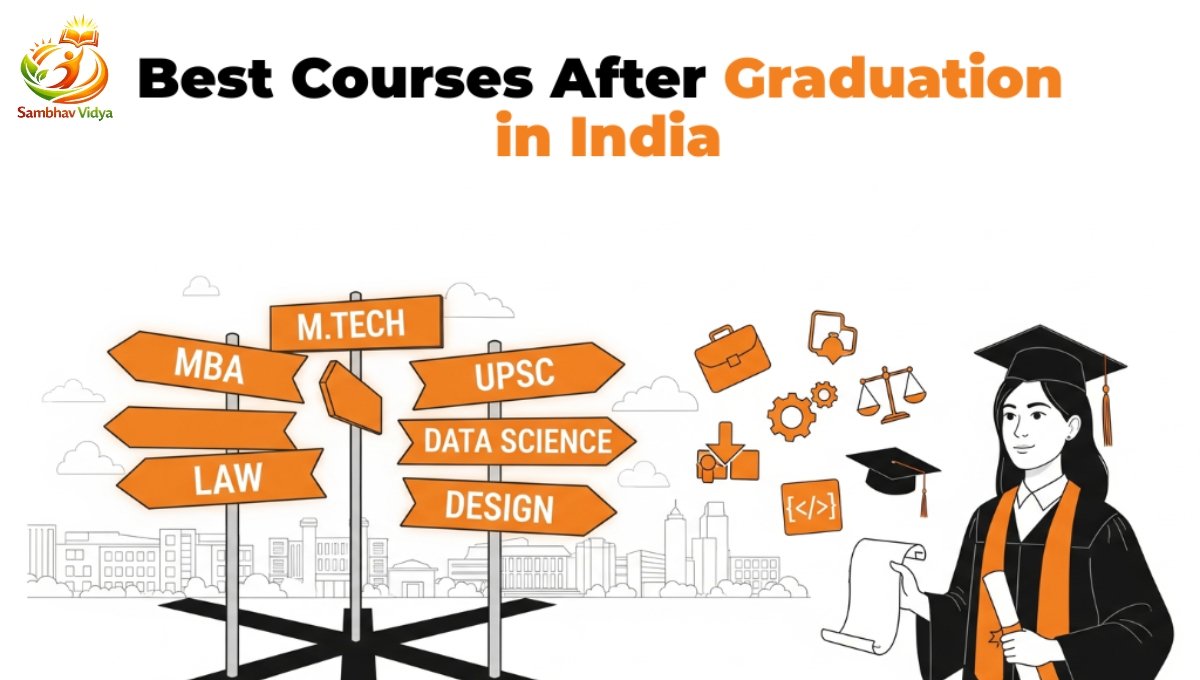
You can broadly choose between higher education, professional qualifications, government careers, private-sector employment, skill-based careers and entrepreneurship.
| Career Path | Common Next Step | Suitable For |
|---|---|---|
| Higher Studies | MA, MSc, MCom, MBA, MCA etc. | Students wanting specialization |
| Management | MBA/PGDM | Business and corporate careers |
| Government Jobs | UPSC, SSC, PSC, Banking etc. | Public-sector aspirants |
| Banking & Finance | Bank exams/finance courses | Commerce and finance enthusiasts |
| Technology | Coding, AI, Data, Cybersecurity | Technology-oriented graduates |
| Digital Marketing | Certification + practical work | Creative and digital learners |
| Human Resources | HR course/MBA/entry-level job | People-oriented graduates |
| Law | LLB | Students interested in legal careers |
| Teaching | B.Ed./PG + applicable eligibility | Teaching aspirants |
| Research | Master’s + research qualifications | Academic and research careers |
| Sales | Entry-level job + experience | Strong communicators |
| Entrepreneurship | Business development | Future business owners |
| Freelancing | Specialized skill + portfolio | Independent workers |
The best choice depends on your degree, interests, financial situation and long-term goals.
For many students, graduation is not the end of education.
A master’s degree can help you develop specialized knowledge and may be important for certain careers.
Students can consider courses such as:
| Graduation Background | Possible Higher Studies |
|---|---|
| BA | MA, MBA, LLB, Journalism, Public Policy |
| BCom | MCom, MBA, Finance, CA, CMA, CS |
| BBA | MBA, PGDM, Business Analytics |
| BSc | MSc, MCA, Data Science, Biotechnology |
| BCA | MCA, Data Science, Cybersecurity |
| BTech | MTech, MBA, MS, specialized technology courses |
| Psychology-related degree | MA/MSc Psychology, specialized programmes |
| Economics | MA Economics, Finance, Analytics |
| English | MA English, Journalism, Communication |
The National Education Policy framework promotes multidisciplinary and flexible higher education, including mechanisms such as the Academic Bank of Credits and multiple entry and exit provisions.
That gives students more flexibility than the traditional idea that one bachelor’s degree must lead directly to one specific profession.
The Master of Business Administration remains one of the most popular choices for graduates from different academic backgrounds.
An MBA can help students move towards:
The important thing is to understand that not every MBA delivers the same career outcome.
The institution, specialization, internship experience, placement opportunities, previous education and your own skills can make a major difference.
Before choosing an MBA, compare:
A strong MBA can be a career accelerator. A poorly chosen programme can become an expensive detour.

Government jobs continue to attract graduates because of their structured career paths and public-service opportunities. Depending on eligibility, graduates can explore examinations and recruitment routes such as:
The Directorate General of Employment publishes information on job opportunities across government recruitment channels and notes that its employment bulletin draws information from bodies including UPSC, SSC, State PSCs, Railway Recruitment Boards and universities.
| Examination | Broad Career Area | Graduation Required? |
|---|---|---|
| UPSC Civil Services | Administration and public services | Yes, subject to notification |
| SSC CGL | Central government departments | Yes, subject to notification |
| State PSC | State government services | Usually graduate-level |
| Banking Exams | Banking | Depends on notification |
| Insurance Exams | Insurance sector | Depends on notification |
| Railway Exams | Various government roles | Depends on post |
| Defence Exams | Defence services | Depends on examination |
| Teaching Recruitment | Government education | Depends on qualification |
Government examinations are highly competitive. They require consistent preparation rather than occasional studying.
If you decide to follow this path, select a specific examination and understand its syllabus, eligibility, exam pattern and previous-year trends before starting preparation.
The UPSC Civil Services Examination is one of India’s most competitive career examinations.
Graduates from different disciplines can pursue it if they meet the applicable eligibility conditions.
The preparation covers broad areas such as:
Your graduation subject can become useful, especially if you choose an optional subject related to your academic background, where applicable.
But UPSC should not be selected simply because someone told you that it is the “best government job.”
It is a demanding journey and requires genuine interest in public administration and sustained preparation.
SSC CGL is another major route for graduates interested in central government employment.
It recruits candidates for different posts across government departments, with the exact positions and eligibility varying by recruitment cycle.
Preparation generally involves areas such as:
Always use the latest official SSC notification for current eligibility and examination details.
Banking is another popular option, especially for Commerce, Economics, Management and other graduates interested in finance.
Depending on the recruitment process, you can explore roles related to:
The Institute of Banking Personnel Selection and individual banks publish their own recruitment notifications, so eligibility and selection processes should be checked for each examination.
Banking can be attractive if you prefer a structured professional environment and enjoy dealing with customers, financial products and business transactions.
You do not necessarily need another degree before entering the workforce.
In fact, starting a job after graduation can help you understand what you actually enjoy.
Entry-level jobs can be found in areas such as:
| Industry | Possible Entry-Level Roles |
|---|---|
| IT | Support Executive, Junior Developer, QA |
| Finance | Finance Executive, Accounts Executive |
| Marketing | Marketing Executive |
| HR | HR Executive, Recruiter |
| Sales | Sales Executive, Business Development Executive |
| Operations | Operations Executive |
| E-commerce | E-commerce Executive |
| Media | Content Executive |
| Customer Service | Customer Support Executive |
| Research | Research Assistant |
| Education | Academic Coordinator |
| Healthcare | Administration/Operations roles |
The National Career Service provides job-search and career services covering private and government opportunities, job fairs, career counselling and skill-development information.
Technology is no longer limited to students with a traditional engineering degree.
Graduates from several backgrounds can transition into technology by learning relevant skills.
Popular areas include:
The World Economic Forum’s Future of Jobs research identifies analytical thinking as a leading core skill for employers, while technological literacy, creative thinking and adaptability are also increasingly important.
This is particularly important for graduates because employers are increasingly looking beyond academic qualifications.
AI is changing the way businesses operate.
Companies are using AI for customer support, software development, research, marketing, finance, automation and data analysis.
Students interested in this field can build knowledge in:
The important thing is to avoid treating AI as a shortcut to a huge salary.
It is a technical field, and strong opportunities generally require strong fundamentals.
The World Economic Forum’s India-focused analysis notes that employers are looking for more technology talent as the country expands its digital and AI capabilities.
Data has become one of the most valuable resources for modern businesses.
A data professional helps companies understand information and make better decisions.
Possible careers include:
Useful skills include:
You don’t necessarily have to become a mathematician to enter analytics, but you should be comfortable with numbers, logical thinking and problem-solving.
As more businesses depend on digital systems, protecting those systems becomes increasingly important.
Cybersecurity professionals work on areas such as:
Graduates can enter the field through computer science, IT, cybersecurity programmes or specialized training.
Cybersecurity is a field where learning never really stops because threats and technologies keep evolving.
Digital marketing is an attractive career for graduates who enjoy communication, creativity and technology.
You can specialize in:
Possible job roles include:
| Role | Primary Work |
|---|---|
| SEO Executive | Search optimization |
| Social Media Executive | Social media management |
| Content Writer | Digital content |
| Performance Marketer | Paid advertising |
| Digital Marketing Executive | Multiple digital channels |
| SEO Content Strategist | Content and search strategy |
| E-commerce Executive | Online business operations |
The biggest advantage of digital marketing is that you can start building practical experience relatively early.
Create a website. Manage a small social-media account. Work on a mock advertising campaign. Write articles. Learn analytics.
A portfolio can show employers what you can do.
If you enjoy working with people, Human Resources can be an interesting career.
Graduates can begin in recruitment, HR operations or administrative roles and later specialize.
Career areas include:
An MBA or postgraduate HR specialization can help candidates who want to progress into managerial positions.
Commerce and finance graduates have several opportunities in accounting and financial services.
Potential roles include:
Professional qualifications such as CA, CMA and CS can provide additional specialization.
The key is to decide whether you want a general corporate finance career or a specialized professional path.
CA remains one of India’s major professional qualifications for students interested in accounting, taxation, audit and finance.
The Institute of Chartered Accountants of India provides the qualification structure, examinations and practical training requirements.
Career opportunities can include:
It is a demanding qualification, so students should enter the field because they are genuinely interested in accounting and finance rather than simply chasing a salary figure.
Graduates interested in corporate regulations and governance can consider Company Secretary (CS).
The career can involve:
The Cost and Management Accountancy (CMA) route is another option for students interested in costing, budgeting, management accounting and financial decision-making.
Both are specialized professional careers and require commitment to their respective qualification processes.
Graduates from many disciplines can pursue a three-year LLB, subject to the eligibility requirements of the institution.
Law can lead to careers in:
If you enjoy reading, writing, research and logical argument, law can be an exciting career.
Teaching can be deeply rewarding for students who enjoy explaining concepts and working with learners.
Depending on the level and institution, graduates may pursue qualifications such as B.Ed. and then meet applicable teacher eligibility and recruitment requirements.
Teaching opportunities can include:
Eligibility varies according to the subject, school system, state and recruitment body, so students should check the latest applicable rules.
Sales is often underestimated by fresh graduates.
But good sales professionals learn some of the most valuable business skills, including:
A graduate can begin as a sales or business development executive and eventually move into account management, regional management or business leadership.
If you’re confident, energetic and comfortable talking to people, this can be a strong career starting point.
Not every graduate dreams of working for a large organization.
Some want to build something of their own.
Graduation can provide a useful foundation, but entrepreneurship requires more than a degree.
You need to understand:
You could start an e-commerce business, digital agency, education service, consulting firm or another venture based on your skills and market needs.
Start small whenever possible.
Test your idea before putting a large amount of money into it.
Freelancing can provide another route for graduates who have a marketable skill.
Popular freelance areas include:
But freelancing isn’t instant money.
You need a skill, portfolio, communication ability and the patience to find clients.
Think of freelancing as building a professional service business rather than simply searching for quick online work.
The job market is changing quickly.
The current Indian employment environment is showing increasing attention to skills related to technology, AI, digitalisation and specialized expertise. The 2026 India Skills Report figures cited by the Government of India indicate an improvement in graduate employability, while current hiring reports show employers becoming more targeted in the skills they seek.
Some emerging areas worth exploring include:
This does not mean every student needs to become an AI engineer.
It means that digital awareness is becoming useful across many different careers.
A degree is important, but the workplace asks a different question:
“What can you actually do?”
According to Mercer | Mettl’s India Graduate Skill Index 2025, only 42.6% of Indian graduates assessed as job applicants were classified as overall employable, while employers increasingly emphasized soft skills such as critical thinking, communication and learning agility.
That gap is a useful warning for students.
You can improve your career readiness by developing:
You don’t need to master everything.
Choose skills that complement your chosen career.
An internship can give you something your degree certificate cannot provide: real-world experience.
Deloitte India’s 2026 campus hiring research reports that organizations are strengthening internship-to-hire programmes and increasingly using internships as indicators of future workplace performance.
That makes internships particularly valuable for students and fresh graduates.
An internship can help you understand:
What does this job actually involve?
That answer can save you from spending years preparing for a career you don’t enjoy.
Your graduation subject can influence your starting point, but it does not have to determine your entire future.
| Degree | Major Career Directions |
|---|---|
| BA | Government, Law, MBA, Media, HR, Marketing |
| BCom | Finance, Banking, CA, CMA, MBA |
| BBA | Management, Marketing, HR, Finance, Sales |
| BSc | Research, Data, Healthcare, Technology |
| BCA | Software, Data, Cybersecurity, IT |
| BTech | Technology, AI, Engineering, Management |
| Economics | Finance, Analytics, Policy, Banking |
| Psychology | HR, Counselling-related pathways, Research |
| English | Content, Media, Teaching, Communication |
| Political Science | Government, Policy, Law, Research |
Your academic background gives you a starting advantage, but additional skills can completely change the direction of your career.
This is a major decision for fresh graduates.
| Factor | Higher Studies | Job |
|---|---|---|
| Main Benefit | Specialization | Practical experience |
| Income | Usually delayed | Begins earlier |
| Cost | Tuition and related expenses | Usually lower immediate cost |
| Experience | Through internships/projects | Direct workplace experience |
| Best For | Specialized careers | Students ready to work |
| Flexibility | Depends on programme | Can learn while working |
| Career Growth | Qualification + skills | Experience + skills |
There is no universal winner.
If you have a clear professional goal that requires another qualification, higher studies can make sense.
If you’re unsure about your career, getting a job or internship can sometimes help you understand yourself better.
This is probably the question most students want answered.
But there is no single salary for graduates.
Your salary can depend on:
A graduate working in a small company may earn much less initially than someone with similar qualifications working for a large organisation.
Similarly, two people with the same degree can have completely different salaries five years later because one developed specialised skills while the other stayed in a general role.
So don’t focus only on your first salary.
Focus on the value of the skills you will develop.
Imagine two jobs. The first pays ₹30,000 per month but teaches you almost nothing new. The second pays ₹25,000 but gives you exposure to clients, analytics, technology and business decisions. Which one could be more valuable after three years? There is no automatic answer, but the example highlights an important truth. Your career is a long journey. A slightly lower starting salary can sometimes lead to stronger opportunities if the role gives you valuable experience and a clear growth path.
If you’re confused about your future, don’t try to solve your entire life in one afternoon.
Start small.
Ask yourself:
Don’t research fifty options.
Pick three realistic paths and compare them.
For example:
MBA + Corporate Career
Government Exams
Digital Marketing + Private Job
Then compare their cost, time, difficulty, earning potential and lifestyle.
Don’t wait for the perfect career decision before learning.
Choose one useful skill such as:
Apply for internships, projects, part-time opportunities or entry-level jobs where appropriate.
Experience will help you understand whether your chosen field actually suits you.
After six months, ask yourself:
Am I learning?
Am I becoming more employable?
Do I still want this career?
If the answer is no, changing direction is not failure.
It is better to change direction early than spend years walking down the wrong road.
| Career | Additional Qualification | Difficulty | Growth Potential | Suitable For |
|---|---|---|---|---|
| Software Development | Technical skills | Moderate to High | Very High | Technology lovers |
| AI/ML | Specialised technical skills | High | Very High | Analytical students |
| Data Science | Specialised skills/PG | High | Very High | Data-oriented students |
| MBA | MBA/PGDM | Moderate to High | High | Management aspirants |
| CA | Professional qualification | High | Very High | Finance students |
| Banking | Competitive exams | Competitive | High | Finance/business graduates |
| Government Services | Competitive exams | Very High | Strong | Public-service aspirants |
| Law | LLB | Moderate to High | High | Analytical readers |
| HR | HR qualification/experience | Moderate | High | People-oriented students |
| Digital Marketing | Practical skills | Moderate | High | Creative graduates |
| Sales | Experience | Moderate | High | Strong communicators |
| Business Analytics | Specialized skills | Moderate | High | Business + data learners |
| Entrepreneurship | Business skills | High uncertainty | Potentially Very High | Business-minded people |
Disclaimer: This article is intended for general educational and career-planning purposes only. Career opportunities, salary ranges, admission requirements, examination patterns, eligibility criteria, recruitment rules and professional qualifications can change over time. The information provided here should not be treated as a guarantee of employment, salary or admission.
Government examinations such as UPSC, SSC, banking and State PSC examinations have their own eligibility conditions and recruitment notifications. Students should always check the latest official notification before applying. Similarly, students considering higher education should verify the recognition and current status of the university and programme through the appropriate official authority.
Salary figures mentioned in this article are indicative rather than guaranteed. Actual earnings can vary considerably depending on qualifications, employer, location, skills, experience, industry and individual performance.
Most importantly, do not choose a career only because it appears on a list of “high-paying jobs.” Consider your interests, strengths, financial circumstances, learning ability and long-term goals before making an important educational or career decision.