By Viraj • September 4, 2026
The Best Drone Training Institute In India: Choosing a drone training institute can feel exciting at first. You may have seen drones being used in farming, construction, photography, surveying, filmmaking or infrastructure inspection and thought, “Maybe I can build a career in this too.” And honestly, it is a field worth exploring.
But there is one thing you should understand before paying for any drone course. Not every institute offering drone training provides the same level of education, practical experience or regulatory value.
A professional drone pilot needs much more than the ability to make an aircraft take off and land. You need to understand airspace, aviation rules, weather, flight planning, emergency procedures, equipment maintenance and safe operations. If your goal is commercial or professional drone work, the training organisation and the credential you receive can make a major difference.
In India, the Directorate General of Civil Aviation, or DGCA, regulates civil aviation and maintains the regulatory framework for drones. DGCA also maintains information on approved Remote Pilot Training Organisations, commonly called RPTOs. As of September 2026, the DGCA dashboard shows 282 RPTO approvals recorded to date, highlighting how significantly the professional drone-training ecosystem has expanded.
This growth is good news for aspiring drone pilots because there are more training choices than before. However, more choices also mean that students need to be careful.
A glossy website, attractive advertisement or promise of a “100% job” should never be enough to make your decision. The real question is simple: How do you know whether a drone training institute is actually worth your time and money? Let us understand everything you should check before joining one.
Drone training is not just another short-term computer course. You are learning to operate an aircraft, and safety has to be at the centre of your education. A good institute should teach you both theory and practical flying. You should understand what you are doing, why you are doing it and what to do when something goes wrong. DGCA’s published training syllabus covers subjects including air law, Drone Rules, airspace, principles of flight, ATC procedures, fixed-wing, rotorcraft and hybrid operations, meteorology, crew resource management, instrument flying, weight and balance, performance, maintenance, risk assessment, emergency procedures, payload operations and drone data analysis.
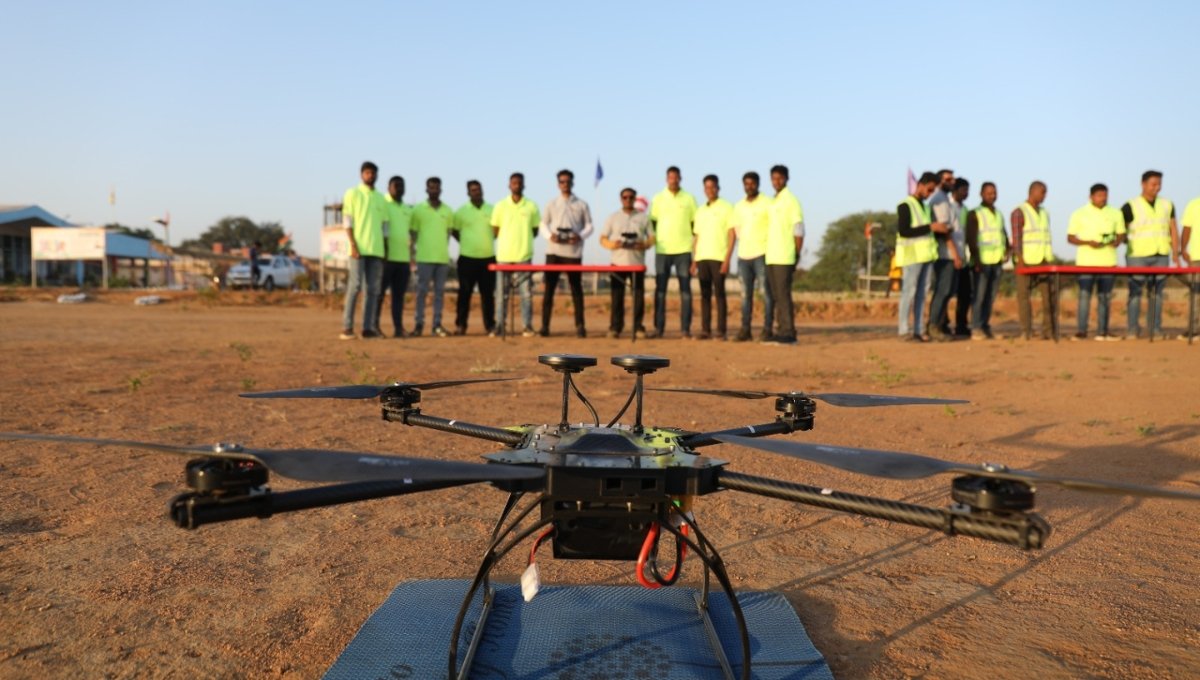
That gives you an important clue about what professional training should look like. If an institute tells you that you can become a professional drone pilot after sitting in a classroom for a few hours and barely touching a real drone, you should think twice.
RPTO stands for Remote Pilot Training Organisation. An RPTO is an organisation authorised by DGCA to provide specified remote-pilot training. The important word here is “specified.” Approval does not necessarily mean that an organisation can conduct every possible type of drone training.
DGCA’s public information includes an RPTO Approved Scope, allowing candidates to verify the scope of an organization’s authorization. This is one of the first things you should check before joining.
In May 2025, DGCA issued a public notice stating that RPTOs and Train the Trainer organisations must make important information about their authorisation publicly available. The notice specifically highlighted the authorisation number, scope, validity, addresses, flying grounds, UAS and simulator information, because candidates had been receiving misleading information about RPTOs through websites and social media platforms.
In other words, verification is not optional if you want to make a smart decision.
Before paying an admission fee, visit the official DGCA website and check the RPTO’s current authorisation.
Do not rely only on a screenshot sent by an institute on WhatsApp. Ask the organisation to show you its current authorisation certificate and compare the details with the official DGCA information.
The following table gives you a simple checklist.
| What to Verify | Why It Matters |
|---|---|
| DGCA Authorization | Confirms regulatory status |
| Authorization Number | Helps identify the organisation |
| Approved Scope | Shows what training it is authorised to provide |
| Validity | Confirms whether authorisation is current |
| Training Base | Confirms where training is actually conducted |
| Flying Ground | Important for practical training |
| Drone/UAS Details | Shows what equipment is available |
| Simulator | Useful for controlled practice |
| Instructors | Determines training quality |
| Certificate Details | Helps understand what credential you receive |
A genuine institute should be comfortable providing this information.
If someone becomes uncomfortable when you ask for authorisation details, that is a warning sign.
This is one of the most important things a beginner should understand. The market contains many courses described as drone pilot courses, drone certification courses, UAV workshops and professional drone programs. They may be useful for learning a particular skill, but that does not automatically mean they are equivalent to DGCA-authorized remote pilot training. A private institute can teach you drone photography, drone assembly, GIS mapping or recreational flying and provide its own certificate. That certificate may still have educational value, but it should not be confused with a regulatory credential. Before enrolling, ask a direct question:
“Exactly what certificate or credential will I receive after completing this course?”
Then ask who issues it and whether the training is being delivered under the institute’s current DGCA authorisation. This small conversation can save you from a very expensive misunderstanding.
A good drone institute should have a clearly defined syllabus. Do not simply look for words such as “advanced,” “professional” or “industry-ready.” Those are marketing terms. Look at what you will actually study.
DGCA’s published syllabus provides a useful benchmark. It includes aviation law, airspace, principles of flight, ATC procedures, aerodynamics, meteorology, maintenance, safety management, risk assessment, emergency procedures, payload use and drone data analysis.
A professional course should give students enough theoretical understanding to operate safely and confidently.
| Training Area | What You Should Learn |
|---|---|
| Drone Fundamentals | Components and aircraft systems |
| Flight Principles | How drones respond during flight |
| Airspace | Where and how drones may operate |
| Regulations | Applicable aviation and drone rules |
| Meteorology | Wind, weather and visibility |
| Flight Planning | Planning safe missions |
| Emergency Procedures | Handling unexpected situations |
| Maintenance | Basic inspection and equipment care |
| Simulator Training | Controlled flight practice |
| Practical Flying | Real-world drone operation |
| Payload | Safe use of cameras and other equipment |
| Data | Understanding collected drone information |
If the course curriculum is vague, ask for a detailed syllabus before paying.
This is probably the biggest difference between a meaningful drone course and a weak one. You can learn theory from a book or online video. Flying requires practice. A good institute should provide sufficient hands-on training and allow every student to operate the aircraft under proper supervision. The earlier Drone Rules framework itself required an RPTO to have enough drones and related equipment to ensure adequate hands-on practical training opportunities for students, along with appropriate instructors and training infrastructure.
Therefore, ask the institute how many students will be in your batch and how much actual flying time each student can expect. Imagine joining a class with 30 students and one drone. You might spend most of the day watching someone else fly. That is not the kind of practical exposure you want.
A drone training institute needs an appropriate location for practical training. Ask where the actual flying sessions take place. Is it on the institute’s own training ground? Is it rented? How far is it from the classroom? How frequently will students travel there?
You should also understand whether the flying location is part of the organization’s approved scope, where applicable. A professional institute should be transparent about its training base and flying ground.
DGCA’s mandatory public disclosure framework specifically requires relevant RPTO information to be made available for each base, including addresses and flying-ground details.
A drone may look easy to operate when you watch someone else flying it. Teaching someone to fly safely is a different matter. The instructor should be able to explain technical concepts in a way that beginners understand. They should be comfortable discussing regulations, weather, aircraft limitations, emergency procedures and real-world flying challenges.
Do not hesitate to ask about the instructors’ qualifications and experience.
| Instructor Quality | Why It Matters |
|---|---|
| Relevant Pilot Qualification | Supports safe instruction |
| Practical Experience | Provides real-world knowledge |
| Teaching Ability | Makes difficult concepts easier |
| Regulatory Knowledge | Helps prevent compliance mistakes |
| Safety Focus | Builds professional habits |
| Industry Experience | Connects training to actual jobs |
An instructor who simply tells you which joystick to move is not enough.
You need someone who can explain what the aircraft is doing and why.
The type and condition of the equipment can significantly influence your learning experience. Ask which drones are used during training. Are they modern enough for the work you want to pursue? Are there multiple aircraft available? Do students learn basic assembly and maintenance?
DGCA’s published syllabus includes drone equipment maintenance as part of training. If your goal is surveying, for example, you may eventually work with drones equipped with specialised cameras or sensors. If your goal is photography, camera operation and image quality become more important. The best institute for one student may therefore not be the best institute for another.
Flight simulators allow students to practice certain situations in a controlled environment before taking responsibility for a real aircraft. A good program may use simulator training to help students understand controls, procedures and specific scenarios. However, simulator training should complement real flying, not replace it.
If an institute advertises an “advanced simulator course” but provides almost no real-world flying, ask questions. The ideal training experience should give you a balance of classroom knowledge, simulator practice and supervised outdoor flying.
Drone training fees can vary considerably depending on the institute, location, certification pathway, course duration, aircraft category, infrastructure and additional services. For example, a 2026 report on Punjab Agricultural University’s DGCA-authorized drone training program noted a course fee of ₹18,000 after the university reduced its earlier fee, while the program included theory, simulator training and practical flying.
This shows why simply searching “cheapest drone course” is not enough.
Compare what is included in the fee.
| Cost Factor | Question to Ask |
|---|---|
| Course Fee | What is the complete amount? |
| GST | Is tax included? |
| Examination | Is the exam fee included? |
| Certification | Are credential-related charges included? |
| Flying | How much practical flying is included? |
| Equipment | Are drones provided by the institute? |
| Simulator | Is simulator training included? |
| Accommodation | Is accommodation available or extra? |
| Food | Is food included? |
| Travel | Is transportation to the flying ground included? |
| Re-training | What happens if you need additional practice? |
A cheap course can become expensive if several important charges appear later.
Likewise, an expensive course is not automatically better.
This is another major red flag. A genuine institute can provide career support, internships, industry exposure or placement assistance. But nobody can honestly guarantee that every student will receive a high-paying job simply because they completed a drone course. Your employment prospects depend on your practical skills, education, location, specialization, communication abilities, experience and the market.
Be particularly careful if an institute promises things such as “guaranteed ₹1 lakh salary” without showing credible evidence. Ask for placement information instead. Find out which companies recruited students, how many students were placed, what roles they received and whether the data refers specifically to your course.
These two phrases sound similar, but they are very different. Placement assistance may include resume support, interview preparation, employer introductions, internships and job leads. Placement guarantee suggests that employment is assured. A responsible institute should explain exactly what it means by “placement support.”
If possible, talk to previous students. Ask them whether the institute actually helped them after training. Sometimes a five-minute conversation with an alumnus can tell you more than an hour spent reading promotional material.
Before choosing an institute, first decide what type of drone career interests you. Someone interested in photography needs different skills from someone interested in surveying. A construction professional may want drone mapping. An agriculture graduate may want precision-farming applications. A GIS professional may want aerial data processing.
| Career Goal | Training Focus |
|---|---|
| Professional Drone Pilot | Regulations + flight operations |
| Drone Surveyor | Flying + surveying |
| GIS Specialist | Drone mapping + GIS |
| Aerial Photographer | Flying + camera operations |
| Agricultural Drone Operator | Flying + agricultural applications |
| Drone Technician | Electronics + maintenance |
| Drone Data Specialist | Mapping + data processing |
| Drone Operations Manager | Compliance + operations + management |
The strongest professionals often combine drone skills with another specialisation.
A civil engineer who understands drone surveying can offer more value than someone who only knows how to fly.
Flying the drone is only half the story in many professional applications. A survey drone may collect hundreds of images. Someone then needs to process those images and convert them into useful information. This is why you should consider learning software and data skills alongside flying.
Depending on your career goal, useful areas can include GIS, photogrammetry, mapping, image processing, CAD or data analysis. DGCA’s training syllabus itself includes an introduction to drone data and analysis, which shows that professional drone operations extend beyond simply controlling the aircraft.
Online reviews can help, but do not trust every five-star rating blindly. Look for detailed reviews from actual students. Pay attention to comments about practical flying, instructors, equipment, scheduling, certification, communication and placement support. A review saying “Amazing institute, best course!” tells you almost nothing. A review explaining how many flying sessions the student received, what aircraft were used and how the instructors handled training is much more useful. Also search for independent discussions rather than relying only on testimonials published by the institute itself.
If you live nearby, visit the training centre before paying. Look at the classroom. Ask to see the drones. Ask where practical training takes place. Talk to the instructors. Observe how they communicate with current students. A physical visit can reveal things that a website never will. If you are enrolling from another city, request a live video tour if a physical visit is not practical.
Several warning signs should make you slow down before enrolling. Be cautious if an institute refuses to show its current authorisation, gives unclear answers about the credential, promises guaranteed employment, cannot explain its practical flying arrangements or pressures you to make an immediate payment. Other warning signs include a suspiciously vague syllabus, extremely large batches with very limited aircraft, unclear fee structures and claims that sound too good to be true.
A professional training organization should be comfortable answering reasonable questions.
Before admission, ask the institute these questions directly:
You do not need to feel awkward asking these questions.
You are investing your money and your time. You deserve clear answers.
If you want a quick way to compare multiple institutes, use this framework.
| Selection Factor | Priority |
|---|---|
| Current DGCA authorisation, where applicable | Very High |
| Correct approved scope | Very High |
| Practical flying time | Very High |
| Qualified instructors | Very High |
| Training infrastructure | High |
| Drone quality and availability | High |
| Safety procedures | Very High |
| Transparent fees | High |
| Industry exposure | Medium to High |
| Placement assistance | Medium |
| Location and accommodation | Medium |
| Reviews and alumni feedback | Medium |
Do not choose an institute simply because it scores well in one category. Look at the complete picture.
Disclaimer: This article is intended for general educational and career-planning purposes only. Drone regulations, training requirements, certification processes, RPTO authorisations, course fees and operational rules can change. The DGCA information referenced in this article reflects official information available at the time of writing, including the current RPTO approval and public-disclosure framework. Students should verify the latest authorisation, approved scope, eligibility requirements and certification process directly through DGCA and the relevant training organisation before making any payment or enrolling in a course. Course completion does not guarantee employment, income or a specific career outcome.