By Viraj • September 18, 2026
Online BBA Admission: Choosing what to do after Class 12 can be exciting, but honestly, it can also feel confusing. There are so many career options available today that students often struggle to decide which course can give them flexibility, practical knowledge and better career opportunities. If you are interested in business, management, marketing, finance, entrepreneurship or the corporate world, an Online BBA can be an interesting option to consider in 2026.
Online BBA allows students to pursue a Bachelor of Business Administration through online learning without attending a traditional college campus every day. It can be particularly useful for students who want flexibility in their study schedule, live away from their preferred university or want to combine education with other responsibilities.
However, choosing an online degree should not be based only on advertisements or attractive fee offers. Students should carefully check the university, programme recognition, eligibility, curriculum, examination system, fees and career support before applying.
An Online BBA, or Bachelor of Business Administration, is an undergraduate management programme delivered primarily through an online learning platform.
The course introduces students to important areas of business and management. Depending on the university, students may study subjects such as accounting, economics, marketing, human resource management, business communication, financial management, operations management, entrepreneurship and business analytics.
The biggest difference between a traditional BBA and an online BBA is the mode of learning. Instead of attending regular classroom lectures on campus, students generally access lectures, study materials, assignments and other academic resources through a digital learning platform.
The exact duration and structure can vary by university, so students should always check the official programme details before admission.
The way students learn and work is changing rapidly. Businesses are increasingly dependent on digital platforms, data, technology and online communication. Because of this, management education is also becoming more flexible and technology-oriented.
An Online BBA can allow students to learn from home while developing fundamental business knowledge. Students can often access recorded or live learning resources according to the university’s system and their schedule.
For someone who wants to start a business, prepare for an MBA, enter sales and marketing, work in operations or explore corporate careers, a BBA can provide a foundation in business concepts.
The online format may also be useful for students who want to continue learning while managing work, internships or other commitments.
The eligibility requirements for Online BBA depend on the university and programme. In many cases, students who have completed Class 12 or an equivalent qualification from a recognised board can apply.
Some universities may specify a minimum percentage, while others may have different subject or admission requirements. Certain institutions may also accept students from different academic streams, meaning students from commerce, science or humanities backgrounds may be eligible depending on the programme rules.
Because eligibility can differ significantly, students should carefully read the official admission notification of the university they want to join.
| Eligibility Factor | General Requirement |
|---|---|
| Educational Qualification | Class 12 or equivalent |
| Recognised Board | Usually required |
| Stream | Depends on the university |
| Minimum Marks | Varies by institution |
| Entrance Test | May or may not be required |
| Age Limit | Depends on university rules |
| Admission Mode | Online application |
Students should not assume that the eligibility criteria of one university automatically apply to another.
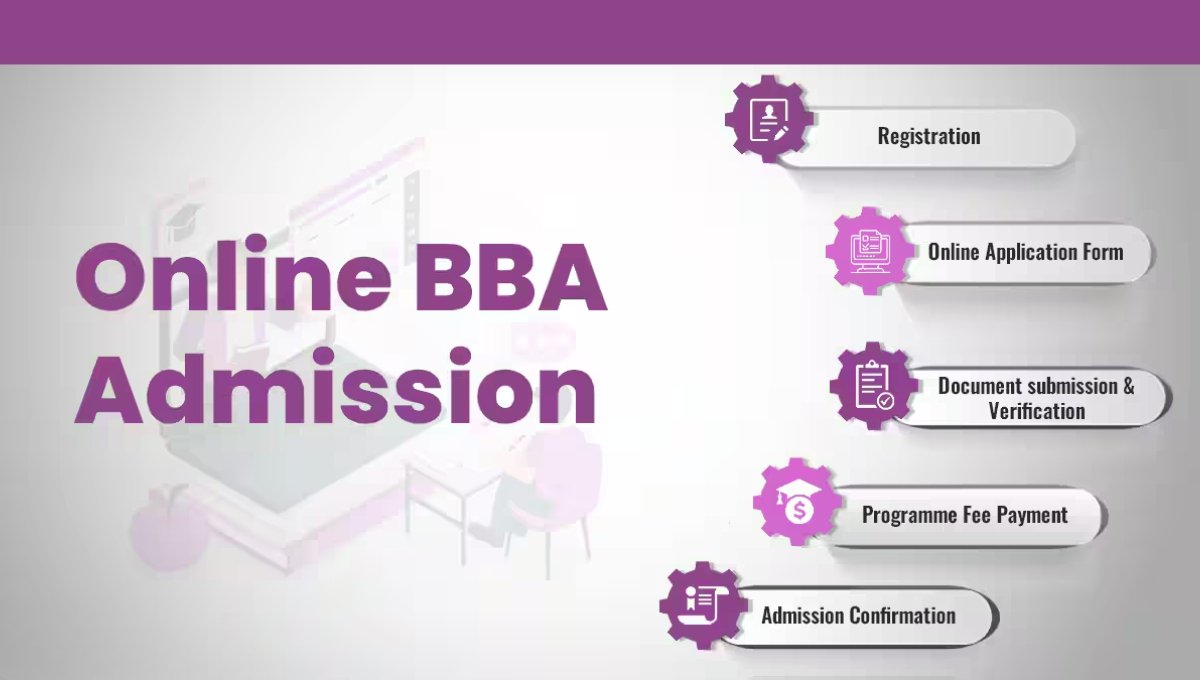
The admission process for an Online BBA is generally straightforward. Students usually begin by visiting the official website of the university and selecting the Online BBA programme.
After checking the eligibility criteria, the student completes the online application form and provides the required academic and personal information. Documents such as Class 10 and Class 12 certificates, photographs, identity proof and other documents may be requested.
After document verification, eligible students may be asked to complete the fee payment and admission confirmation process.
For programmes covered under UGC’s Online Learning framework, students should also check the UGC-DEB status of the university and the specific programme for the academic session in which they are taking admission. UGC-DEB specifically advises learners to verify the recognition or entitlement status before enrolling.
One of the most important things students should understand before taking admission is the DEB ID.
According to the UGC Distance Education Bureau, a DEB ID is mandatory for learners who wish to take admission in recognised Open and Distance Learning or Online programmes. It is created using the learner’s ABC ID.
The purpose of the DEB ID is to help ensure that students are enrolling in recognised or entitled higher educational institutions and approved programmes.
For the August 2026 session, the UGC-DEB portal currently states that the last date to admit learners in ODL/Online programmes is 13 October 2026. Students should still check the official UGC-DEB portal for any subsequent updates before completing admission.
The exact document list varies from one university to another. However, students may generally be asked to provide their Class 10 and Class 12 marksheets or certificates, identity proof, passport-size photograph, signature and other personal information.
If a student belongs to a category that requires supporting documentation, the relevant certificate may also be required.
Before submitting the application, it is better to keep clear digital copies of the required documents ready. This can make the online admission process much easier and reduce the possibility of delays.
The fee for an Online BBA can vary considerably depending on the university, programme structure, specialisation, learning resources and additional services.
Some institutions offer relatively affordable programmes, while private universities and premium online education providers may charge higher fees.
Students should not compare universities only on the basis of total tuition fees. They should also check whether examination fees, registration charges, study materials, technology fees or other costs are included.
| Fee Factor | What Students Should Check |
|---|---|
| Tuition Fee | Total programme cost |
| Registration Fee | One-time admission charges |
| Examination Fee | Whether included or separate |
| Learning Resources | Digital material, lectures and LMS |
| Scholarships | Availability and eligibility |
| Payment Options | Semester-wise or annual payment |
The final fee should always be confirmed from the university’s official website because fee structures can change.
Although the syllabus differs between universities, most BBA programmes introduce students to fundamental areas of business.
Common subjects may include Financial Accounting, Business Economics, Marketing Management, Human Resource Management, Business Communication, Business Statistics, Financial Management, Operations Management and Entrepreneurship.
Some modern programmes may also include subjects related to digital marketing, business analytics, e-commerce, information technology and data-driven decision-making.
| BBA Subject | Main Learning Area |
|---|---|
| Financial Accounting | Understanding business accounts |
| Marketing Management | Customers, markets and branding |
| Business Economics | Economic concepts for business |
| Human Resource Management | People and workplace management |
| Financial Management | Business finance and investment |
| Business Statistics | Data and quantitative analysis |
| Operations Management | Business processes and efficiency |
| Entrepreneurship | Startups and business creation |
| Business Communication | Professional communication |
| Business Analytics | Data-based business decisions |
The exact semester-wise syllabus should be checked on the university’s official programme page.
Some universities provide general BBA programmes, while others may offer specialised pathways.
Depending on the institution, students may find options related to Marketing, Finance, Human Resources, International Business, Digital Marketing, Business Analytics, Entrepreneurship or other management areas.
A specialisation can help students develop deeper knowledge in a particular field, but students should first understand their interests and long-term career plans before selecting one.
The UGC-DEB maintains an official database of universities and programmes approved or entitled for Online and ODL education. The database is particularly important because recognition can vary by academic year and programme.
The UGC-DEB programme database has listed Online BBA programmes at various institutions in recent sessions, including Bharati Vidyapeeth, Noida International University, Guru Kashi University, Shoolini University and Guru Gobind Singh Indraprastha University among the entries visible in the database. However, students must verify the 2026-27 status of the exact university and BBA programme before admission rather than relying on an older session’s listing.
This is especially important because UGC explains that recognition for a previous academic year does not automatically establish recognition for the next session.
An Online BBA and a regular BBA can cover many similar management concepts, but the learning experience is different.
A regular BBA generally involves physical classroom attendance, campus activities and face-to-face interaction. An Online BBA focuses more heavily on digital learning.
For students who prefer a flexible schedule, online education can be convenient. Students who strongly prefer daily classroom interaction, campus life and physical activities may prefer a conventional programme.
The right choice depends on the student’s learning style, circumstances, career plans and the quality of the institution.
An Online BBA can provide a foundation for several business-related career paths.
Graduates may explore opportunities in areas such as sales, marketing, business development, customer relationship management, operations, administration, finance support and human resources, depending on their skills and the requirements of individual employers.
Students can also choose higher education after completing their BBA. An MBA is one of the most common postgraduate options for graduates who want to develop advanced management knowledge.
Those interested in entrepreneurship can also use their BBA knowledge while developing their own business idea.
However, a degree alone does not guarantee a job. Practical skills, communication ability, internships, digital knowledge, analytical thinking and relevant work experience can make an important difference in the early stages of a career.
For students who want to study business and management but need greater flexibility than a traditional campus programme provides, an Online BBA can be worth considering.
The most important factor is not simply whether the programme is online. The student should verify the university’s recognition status, programme approval, curriculum, faculty, learning platform, assessment system, student support and career services.
UGC-DEB also advises students to check the recognition status for the specific session in which they are seeking admission.

Before paying the admission fee, students should carefully examine the official programme information. Check whether the university and the specific Online BBA programme are recognised or eligible for the relevant academic session. Verify the complete fee structure and understand whether there are additional charges. Students should also examine the syllabus, examination process, learning platform, academic support, internship opportunities and career assistance. It is equally important to avoid enrolling through unofficial agents or arrangements that are not clearly authorised by the university. UGC-DEB states that universities cannot offer ODL or Online programmes through franchising arrangements with private service providers.
Disclaimer: This article is intended for general educational and informational purposes only. Eligibility criteria, fees, admission dates, syllabus, specialisations, examination patterns and programme availability may vary between universities and can change for the 2026-27 academic session. UGC-DEB recognition or entitlement should always be verified for the specific university, programme and admission session before applying. Students should rely on the latest official university and UGC-DEB information for final admission decisions.